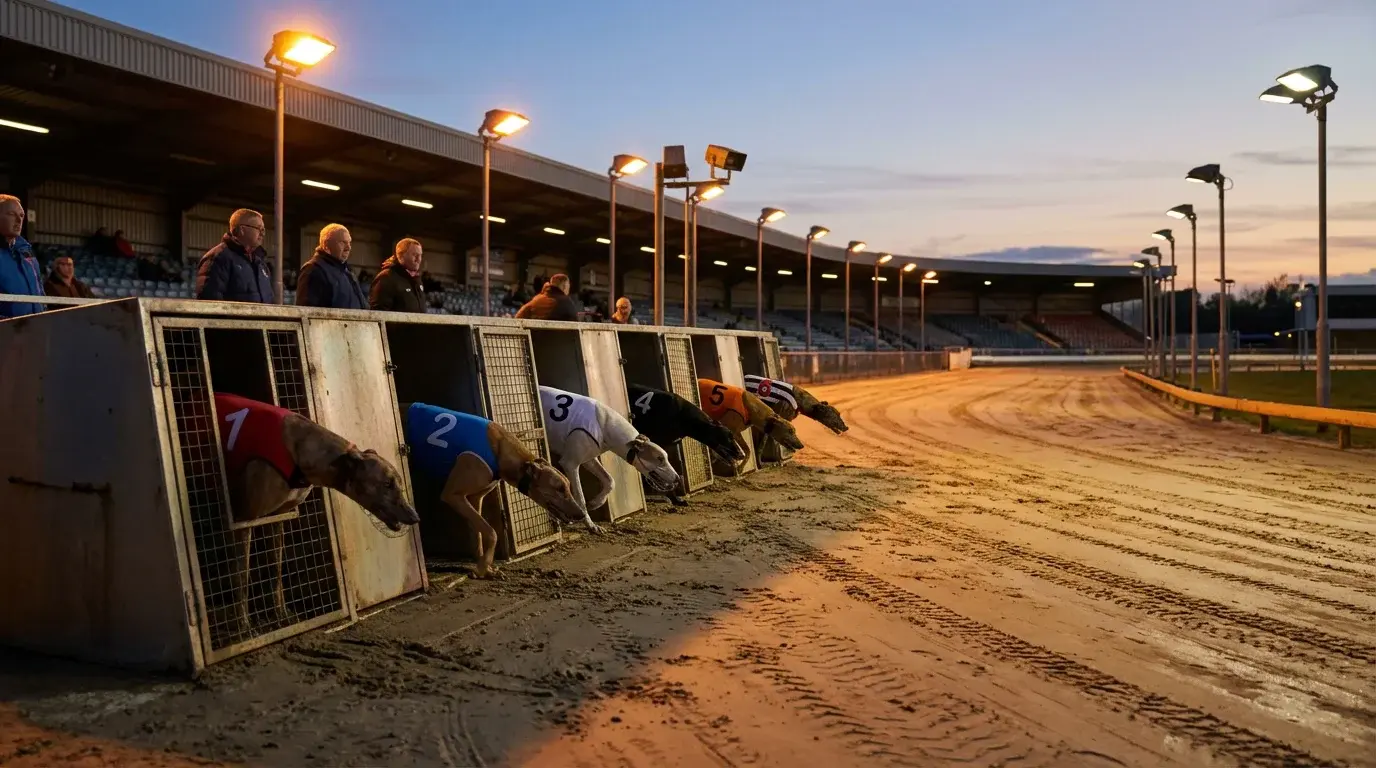
Best Greyhound Betting Sites – Bet on Greyhounds in 2026
Loading...
SP Is the Price at Trap Rise — Nothing More, Nothing Less
SP stands for Starting Price — the odds locked in the moment the traps open. It is not a prediction, not an average, and not the price you necessarily saw when you first looked at the racecard that morning. It is the final number the market settles on when there is no more time left to settle on anything else.
For anyone betting on greyhound racing in the UK, SP is the default settlement price. Unless you actively take an early price — clicking to accept specific odds before the race — your bet is settled at whatever the Starting Price turns out to be. This makes SP the most commonly used pricing mechanism in dog racing, and yet it is also one of the least understood. Plenty of bettors place wagers every week without knowing how the number is derived, what influences it, or whether they would have been better off locking in odds earlier in the day.
That lack of understanding costs money. Not every time, and not dramatically, but consistently. SP is not mysterious — it follows a clear process and responds to identifiable forces. Once you understand those forces, you can make a sharper decision about when to take the price early and when to let SP do its work. The distinction sounds minor until you track it across a hundred bets, and then it stops being minor very quickly.
This guide breaks down exactly what SP means in UK greyhound racing, how the number is produced, how it compares to taking early odds, and how the Best Odds Guaranteed promotion changes the calculus entirely.
How SP Is Calculated at UK Greyhound Tracks
SP comes from on-course bookmakers and the weight of money at the track. In horse racing, the Starting Price is returned by an official SP reporter appointed by the Starting Price Regulatory Commission (SPRC), who surveys the prices offered by on-course bookmakers at the moment the race begins. Greyhound racing follows a similar principle, though the mechanics differ in important ways because the scale of on-course betting is smaller and the frequency of racing is higher.
At a typical UK greyhound meeting, on-course bookmakers set their own prices for each runner in every race. These prices are influenced by the money they take — if a particular dog attracts heavy support, its price shortens because the bookmaker is adjusting liability. Conversely, dogs that attract little interest may drift to longer odds. The SP is determined at the point of trap rise — the instant the race officially starts — and it reflects the consensus of on-course pricing at that exact moment.
Online bookmakers, meanwhile, set their own prices independently. The odds you see on a betting site at 9am may not bear much resemblance to the SP that gets returned at 7:42pm when the traps open. Online prices respond to different volumes, different customer profiles, and sometimes different algorithms. The early-morning price on a greyhound is typically a tissue price — the bookmaker’s initial estimate based on form, ratings, and anticipated market behaviour. As the day progresses and money comes in, those prices move.
It is worth understanding that SP in greyhound racing tends to be less volatile than in horse racing. Fields are smaller — six runners versus fields of eight to twenty or more in horse races — and the volume of on-course money is generally lower. This means the SP on a greyhound favourite might sit at 2/1 from early afternoon and still be 2/1 at trap rise, whereas in a competitive horse race the equivalent price might shift by several points during the final minutes of betting.
That relative stability makes greyhound SP somewhat predictable, but it does not make it optimal. The price at trap rise is not necessarily the best price that was available at any point during the day. It is simply the price at the close. There is a difference, and it matters.
One additional detail: for races broadcast via SIS (Sports Information Services, which supplies live racing to betting shops and online platforms), SP is determined by an official process that aims to reflect the genuine state of the market. For BAGS meetings — Bookmakers’ Afternoon Greyhound Service — the prices are generated with input from the operators that fund those fixtures. The SP on a Monday afternoon BAGS meeting at Sunderland and the SP on a Saturday evening Open race at Romford are both called “SP,” but they exist in different market environments with different levels of liquidity.
Taking the Price Early vs Waiting for SP
Early odds might be generous — or they might shorten into better territory. The decision to take a price or leave it for SP is one of the most common judgment calls in greyhound betting, and there is no universally correct answer. What there is, however, is a framework for making the decision rationally instead of reflexively.
Taking the price early means accepting the odds currently displayed by your bookmaker at the time you place your bet. If you back a dog at 5/1 at 10am, your bet is settled at 5/1 regardless of what happens to the price later. If the dog drifts to 7/1 by trap rise, you have missed out on a better price. If it shortens to 3/1, you have locked in value. The problem, of course, is that you do not know which of those scenarios will materialise when you commit.
Waiting for SP, on the other hand, means you are accepting whatever the market produces at the last moment. You avoid the anxiety of early commitment, but you also give up control. If the dog you fancy attracts heavy support throughout the day, the SP could be significantly shorter than the price that was available eight hours earlier.
Several factors help you assess which approach is likely to serve better in a given situation. First, consider the type of meeting. At a BAGS afternoon fixture with low on-course attendance, SP tends to be relatively stable. Early prices and SP often converge within a point or two. The benefit of taking early here is marginal. At a Saturday evening card or a major competition, however, prices can move more sharply as punters pile in during the final hour before racing. Taking an early price on a fancied dog in a competitive Open race can be worth several percentage points of edge.
Second, consider the dog’s profile. Publicly fancied dogs — those tipped in newspapers, on Timeform, or across social media — tend to shorten as money arrives. If you agree with the consensus, taking the price early protects you from that compression. Untipped dogs with quiet form sometimes drift, and waiting for SP can deliver a longer price. This is not a rule, but a tendency. Track it over a few weeks and the pattern becomes visible.
Third, consider your staking level. For small-stakes recreational bettors, the difference between 3/1 and 10/3 on a single bet is negligible. For anyone operating with a structured bankroll and targeting level-stakes profit, that fractional difference compounds over hundreds of bets. At higher volumes, the early-versus-SP decision becomes a genuine strategic lever rather than a matter of convenience.
The simplest heuristic is this: if you believe the price will shorten, take it early. If you believe it will drift, wait. If you have no strong view, SP is the lazy default — and in greyhound racing, where fields are small and markets are thin, the lazy default is not a terrible option.
How Best Odds Guaranteed Eliminates the SP Gamble
BOG means you cannot lose either way — early price or SP, you get the best. Best Odds Guaranteed is a promotion offered by most major UK bookmakers on greyhound racing, and it fundamentally changes the early-versus-SP calculation described above.
The way it works is straightforward. You take an early price — say 4/1 on a dog in the 7:30 at Romford. The dog shortens to 3/1 by trap rise. With BOG, your bet is still settled at 4/1 because that was the price you took. Now imagine the opposite: you take 4/1 early, but the dog drifts to 5/1 by trap rise. Under BOG, your bet is settled at 5/1 — the better price. You receive whichever is higher: the price you took or the returned SP.
This makes taking an early price with a BOG bookmaker almost always the rational choice. You lock in a floor — you cannot do worse than the price you accepted — while retaining the upside of any drift. The only scenario where BOG does not help is when the price stays exactly the same between your bet and trap rise, in which case it makes no difference at all.
Not all bookmakers apply BOG to every greyhound meeting. Some restrict it to televised races or specific UK fixtures, excluding BAGS meetings or certain afternoon cards. Check the terms before assuming coverage. The big operators — Bet365, William Hill, Coral, Ladbrokes, Paddy Power — all offer BOG on dog racing in some form, but the scope varies. It is also worth noting that BOG typically applies only to win singles, not to forecast, tricast, or accumulator bets.
For any bettor who regularly takes early prices on greyhound racing, using a bookmaker with BOG active is not optional — it is the baseline. Without it, every early-price bet carries the risk of being settled below the SP. With it, that risk disappears. It is the closest thing to a free edge that exists in legal, regulated sports betting.
One practical tip: if you use multiple bookmaker accounts, check which one has BOG active for the meeting you are betting on before placing. A 4/1 with BOG is always worth more than a 4/1 without it, even though the quoted number is identical.
The Number That Sticks
SP is a snapshot — it does not tell you whether the price was right. It tells you where the market stood at one particular moment, and nothing more. A dog that wins at 6/4 SP might have been available at 5/2 that morning. A dog that loses at 8/1 might have been backed down from 14/1. The SP captures the endpoint, not the journey.
The bettors who handle SP well are the ones who stop treating it as either a target or a mystery. It is neither. It is a data point — the last price the market agreed on before the race became a fact. Your job is not to predict the SP. Your job is to decide whether the price available to you, right now, represents value against the probability you have assessed. If it does, take it. If it does not, move on.
With BOG in the picture, the calculus tilts heavily toward taking early prices whenever you have a view. Without BOG, SP remains a reasonable fallback for bettors who lack the time or inclination to monitor price movements through the day. Either way, understanding what SP is and how it is produced puts you ahead of the majority who treat it as a given rather than a mechanism. And in a market as thin as greyhound racing, even a small informational edge matters more than it might in deeper, more liquid sports.