 Available in US
In this guide
What Fast Greyhound Results Actually Tell You — And What They Don't
Every greyhound result that loads on your screen is a compressed packet of data — and most bettors only read half of it. They check the winner, glance at the starting price, maybe note the winning time, and move on to the next race. It feels efficient. It is also a reliable way to miss the information that actually matters.
Fast greyhound results exist because the sport moves quickly. With BAGS meetings running through the day and evening cards stacking up across the country's 18 GBGB-licensed tracks, there can be over 200 races on a busy Saturday. Nobody is going to pore over every piece of data from every race. But there is a significant difference between scanning results for confirmation and scanning them for insight — and that difference separates recreational punters from bettors who consistently find value.
This guide covers the full journey: how UK greyhound results are structured, what each data field actually means, how to read a racecard before a race and interpret the results after it, how form analysis turns raw numbers into patterns, and how those patterns connect to the bets you place. It is not a tips page, and it is not a live results feed. It is the layer of understanding that sits between the results and your next decision.
What are fast greyhound results?
Fast results are the abbreviated outcome of a greyhound race, typically showing the finishing order, winning time, starting prices, and forecast/tricast dividends. They are designed for rapid confirmation — did your dog win, and what did it pay? Full results add sectional times, race remarks, bend positions, going allowance, and calculated times. Fast results tell you what happened. Full results tell you how and why it happened.
How UK Greyhound Results Are Structured
A greyhound result is not a single number — it is a layered record. At its simplest, it tells you which dog crossed the line first and how long the race took. At its most detailed, it provides a near-complete reconstruction of the race: where each dog was at each bend, how the pace unfolded, what the track conditions were, and how the starting price compared to the morning market. Understanding the structure means knowing which layer to look at and when.
Every result published through services like Sporting Life, Timeform, or the GBGB's own results pages follows a broadly consistent format. The race header identifies the track, distance, grade, and time of the race. Below that, the finishing order lists each dog with its trap number, finishing position, distances behind the winner, starting price, and running time. In full results, you will also find sectional times, bend positions expressed in shorthand, race remarks from the judge, and the going correction applied to the raw time.
The data pipeline from track to screen is fast. SIS (Sports Information Services) handles the broadcast and data feed for most UK greyhound meetings, and results are typically available within seconds of the race finishing. Bookmakers receive the same feed, which is why your bet settles almost before the dogs have pulled up. For bettors watching from home or on a phone, fast results land first through betting apps and results portals. Full results, including remarks and calculated times, may take a few minutes longer as the judge and track officials finalise the race record.
The key distinction is intent. Fast results serve the question "what happened?" Full results serve the question "what does this mean for next time?" Both matter, but they serve different moments in the betting cycle.
Fast Results
Finishing order, winning time, SP, forecast/tricast dividends. Best for: confirming outcomes mid-session.
Full Results
All fast result data plus sectional times, bend positions, race remarks, going allowance, calculated time. Best for: post-race analysis and form study.
Racecard
Pre-race data: trap draw, last six form lines, best times, trainer, weight, colour. Best for: pre-race assessment and bet selection.
What Each Data Field Means: SP, Going, Calc Time, Bend Positions
SP is the last price the market agrees on before the traps open. In greyhound racing, starting price is determined by the on-course bookmakers at the track, and it reflects the final balance of money laid against each dog. If you have taken an early price with your bookmaker, SP is irrelevant to your payout — unless you are on Best Odds Guaranteed, in which case you receive whichever is higher. If you have left your bet at SP, this is the price that determines your return. SP appears in every results listing, expressed as a traditional fraction: 5/2, 7/4, 11/8, and so on.
Going allowance is the adjustment applied to account for track surface conditions. UK greyhound tracks run on sand, and sand holds moisture. A wet, heavy surface slows dogs down; a dry, fast surface speeds them up. The going allowance is expressed as a number of hundredths of a second added to or subtracted from the raw finishing time to produce a normalised time that can be compared fairly across different days and conditions. A going allowance of +20 means the track was running slow that day — twenty hundredths of a second are subtracted from each dog's time to reflect what they would have run on a standard surface.
Calculated time is the result of that adjustment: the raw finishing time corrected by the going allowance. This is the number you should use when comparing a dog's performance across multiple races, because it strips out the variable of surface conditions. Two dogs that both ran 29.50 on different days may not have performed equally — if one raced on a -10 going and the other on a +15, the real gap between them is significant.
Bend positions are the shorthand record of where each dog was during the race. They tell you whether a dog led from the first bend, was crowded out at the third, or made a late run from fifth to second down the home straight. The remarks line expands on this with coded observations from the judge — things like "Bmp1" (bumped at the first bend), "Ld3" (led from the third bend), or "RanOn" (finished strongly). Taken together, these fields transform a flat result into a story of how the race actually unfolded.
Fast Results vs Full Results: When to Use Each
Fast results exist for one reason: confirmation at speed. You have a bet running on the 14:36 at Romford, you check the fast results, you see your dog finished second at 7/2, and you move on. That is the designed use case, and the format is optimised for it — stripped back, no commentary, just outcome and price. For anyone betting through the day across multiple tracks, fast results are the heartbeat monitor of their session.
Full results serve a different purpose entirely. They are where you do your homework after the racing is over. If you are studying form for tomorrow's card, you need full results because you need to know how a dog ran, not just where it finished. A dog that finished third but was bumped at the first bend and still closed from four lengths back is a completely different proposition from a dog that finished third after leading for most of the race and fading. Fast results will not tell you that. The remarks, sectional times, and bend positions in full results will.
The practical rule is straightforward. During a live session, use fast results for settlement and immediate decisions. After the session, switch to full results for form analysis, noting the going allowance and calculated times to ensure your comparisons are fair. Trying to do deep analysis from fast results is like reading only the headlines of a match report — you get the score, but you miss the context that explains it.
How to Read a Greyhound Racecard in Under 5 Minutes
The racecard is not a prediction — it is an inventory. It tells you everything the track and the bookmakers know about each dog before the race starts, laid out in a standardised format that takes practice to read fluently but follows the same logic every time. Once you know the structure, five minutes with a racecard will tell you more about a race than watching the last ten replays.
Start at the top. The race header gives you the track name, the race time, the distance in metres, and the grade. The grade is critical: it tells you the class of the race, which in turn tells you the ability band of the dogs running. An A1 race at Romford contains the best-graded dogs at that track. A D3 race is a lower standard. Open races sit outside the regular grading system and attract invited entrants, often the strongest dogs in the country. Knowing the grade helps you calibrate expectations — a 29.00-second run in an A1 race means something very different from a 29.00 in a D4.
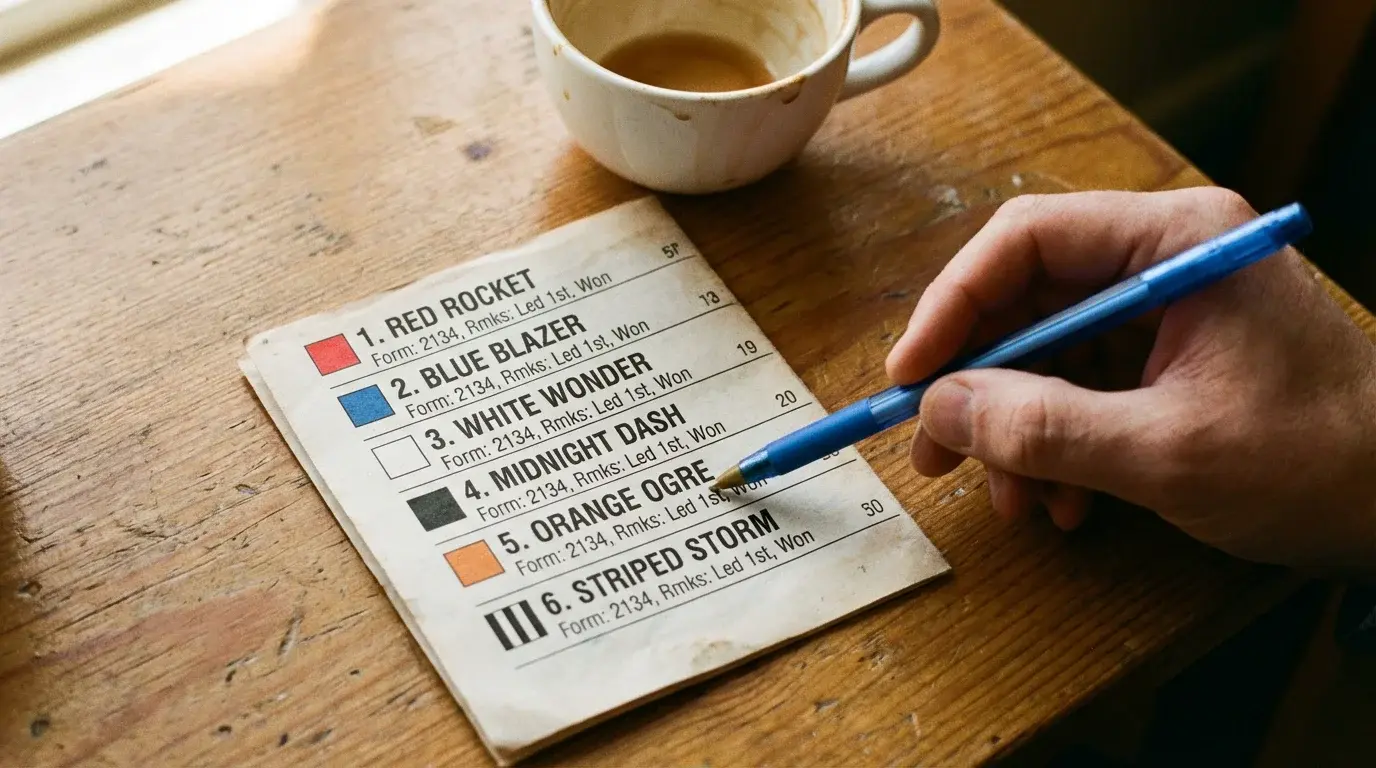
Below the header, each dog gets a line. The trap number and its associated colour are the first thing you see — trap 1 is red, trap 2 is blue, trap 3 is white, trap 4 is black, trap 5 is orange, and trap 6 is striped black and white. After the trap, you get the dog's name, colour, sex, sire and dam, trainer, and weight at last weighing. Then come the form lines: typically the last six runs, showing the date, track, distance, finishing position, times, and race remarks for each.
The form lines are where the racecard earns its weight. Each line compresses an entire race into a row of numbers and abbreviations. Reading them fluently means understanding that "111111" is not just six wins — it is six wins that need context. What grade were those races? What traps did the dog run from? What were the going conditions? Were the times improving or stagnating? The numbers alone do not tell you whether you are looking at a genuine improver or a dog winning at a level it is about to be promoted out of.
Trap 1 — Red
Inside rail. Favours railers with early pace who can hold the bend tightly from the break.
Trap 2 — Blue
Inside-middle. Versatile draw, suits dogs that break well without needing the rail immediately.
Trap 3 — White
Middle. Neutral draw — outcome depends heavily on early pace and what the dogs either side do.
Trap 4 — Black
Middle-wide. Can be advantageous for dogs with strong early pace at tracks with sweeping first bends.
Trap 5 — Orange
Wide. Suits wide runners with tactical speed. Disadvantage at tight tracks where the run to the first bend is short.
Trap 6 — Black and White
Widest draw. Often statistically the weakest position, but some dogs are specialist wide runners who thrive here.
Greyhound Abbreviations That Actually Matter for Betting
You do not need to memorise every code on a racecard — focus on the dozen that shift your decision. Greyhound race remarks use a compressed shorthand that looks impenetrable until you learn the patterns. Most abbreviations describe what happened to a dog during the race: where it was, what interfered with it, and how it ran in the closing stages. Here are the ones that carry the most weight when you are deciding where to put your money.
QAw means the dog was quick away from the traps — a strong early break. This matters enormously at sprint distances where the first bend is reached within seconds. SAw is the opposite: slow away. A dog with SAw in its last few races has a trapping problem, and unless you know why, backing it from an outside draw is risky. EP stands for early pace — the dog showed speed in the first half of the race, regardless of whether it maintained it. Ld followed by a number indicates when the dog took the lead: Ld1 means it led from the first bend, Ld4 means it hit the front at the fourth.
Bmp is bumped — the dog made contact with another runner. This is one of the most important remarks because it explains why a time might be slower than expected or why a dog finished lower than its ability suggests. A dog that ran 30.20 but has "Bmp1,Bmp3" in its remarks probably would have run faster with a clear passage. CrdRun or Crd means the dog was crowded — squeezed for room without necessarily making contact. EvCh stands for every chance, meaning the dog had a clear, unimpeded run and still did not win. That is a less forgiving remark — it suggests the result reflects ability rather than misfortune.
RanOn means the dog finished strongly, closing on the leaders in the home straight. It often signals stamina and could indicate the dog wants a longer distance. ALd means the dog led for all or almost all of the race. Mid, Rls (rails), and Wide describe the dog's running line through the race — useful for understanding whether a dog suits a particular trap draw. A dog described as "Wide" repeatedly is unlikely to produce its best from trap 1.
Using Greyhound Results to Build a Form Picture
Form is not what a dog did — it is the pattern behind what it did. A single result tells you almost nothing reliable. Six results, read together and adjusted for context, start to tell you a story. The skill is in distinguishing between a dog that is genuinely improving and one that has simply had a kind sequence of draws and conditions.
Start with the last six runs, which is the standard form line on any racecard. Read them in chronological order, not just as a sequence of finishing positions. A form line of 321123 reads very differently depending on whether the recent wins came at a higher grade than the early thirds or the same one. Grade changes are the first thing to check: has the dog been promoted after winning, and is the most recent result a first attempt at a higher level? If so, the form line carries an asterisk that the numbers alone do not show.
Next, look at times — but always use calculated times, not raw finishing times. Two runs of 29.40 at the same track could represent completely different levels of performance if one was on a +15 going and the other on a -10. Calculated times normalise for surface conditions, making them the only reliable basis for time comparison. If a dog's calculated times are trending downwards (meaning faster), that is a genuine improvement signal, not just an artefact of weather.
Then read the remarks. A dog that has finished fourth in its last three races but has "Bmp1" or "Crd2" in each of those runs has been unlucky, not poor. Conversely, a dog that has won its last three but shows "EvCh" in prior defeats may simply be running in the right grade now rather than having improved. The remarks add a qualitative layer that pure numbers cannot provide.
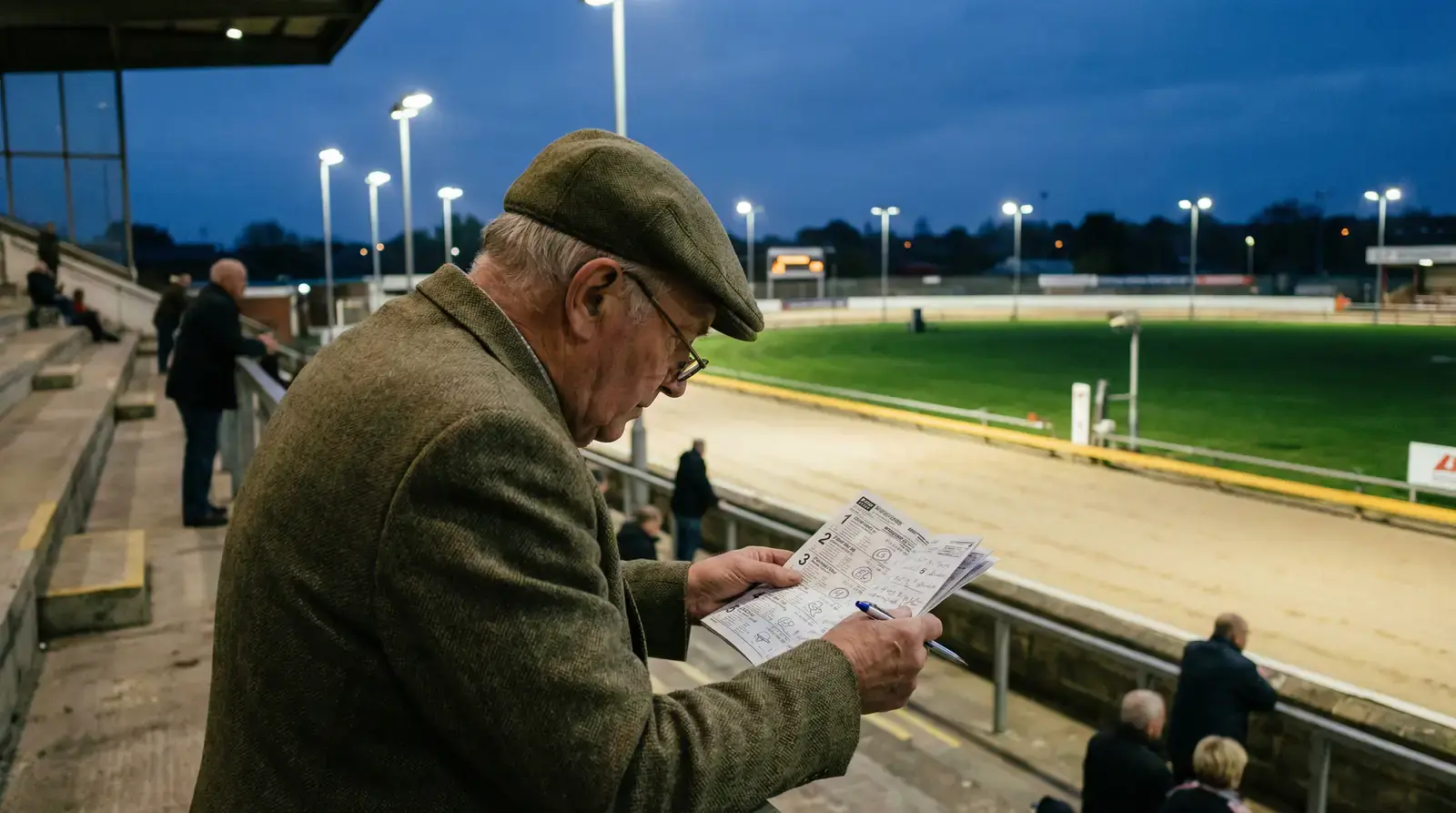
Building a form picture: a step-by-step example
Step 1 — Collect the last six runs. Dog X's form line reads: 4-3-2-1-1-2. Tracks: Romford, Romford, Romford, Romford, Central Park, Central Park. Grades: A3, A3, A3, A2, A1, A1.
Step 2 — Adjust for grade changes. The first four runs were at A3 and A2 level at Romford, the last two at A1 at Central Park. The dog has been promoted and also switched track — both significant variables.
Step 3 — Compare calculated times. Calculated times across the six runs: 29.45, 29.38, 29.30, 29.22, 29.50, 29.35. The improving trend at Romford is clear. The first run at Central Park (29.50) suggests an adjustment period; the second (29.35) shows the dog is adapting.
Step 4 — Read the remarks. Run 5 (the 29.50 at Central Park): "CrdRnUp,SAw". The dog was slow away and crowded on the run-up. That explains the slower time — it was circumstances, not decline. Run 6: "EP,Ld2To4,RanOn". Strong effort, led from the second bend, only headed late.
Step 5 — Identify the angle. This dog is an improving type adjusting to a higher grade and a new track. The calculated times suggest it has the raw ability. The remarks suggest it needs a clean break. If it draws trap 1 or 2 next time at Central Park, where the run to the first bend is longer, the trapping issue is less punishing. That combination — ability, improving trend, favourable draw — is a betting angle.
Trap Draw and Its Impact on Greyhound Results
A dog's trap number is not random noise — it is a variable that changes everything. In a six-runner race around an oval track, the inside trap has the shortest route to the first bend and the outside trap has the widest arc. That geometry alone creates an inherent bias, but the bias is not uniform across all tracks. At Romford, where the run to the first bend is short and the bends are tight, trap 1 historically produces more winners than trap 6. At a track with wider bends and a longer run-in, the advantage shifts.
Running style interacts with trap draw to produce compound effects. A railer — a dog that naturally hugs the inside rail — will perform best from traps 1 or 2, where it can establish its preferred line immediately. Put the same dog in trap 5, and it has to cross four rivals to reach the rail, a manoeuvre that costs lengths and invites trouble. Wide runners face the mirror problem: they want space on the outside to use their stride, and drawing trap 1 forces them into uncomfortable territory.
When you see a racecard and a dog's last six form lines all show runs from trap 2 with strong results, and tonight it has drawn trap 5 at a track it has never raced at, the form line is less predictive than it appears. Trap statistics by track are published on sites like Greyhound Stats and Timeform, and checking them before a race takes thirty seconds. That thirty seconds can tell you whether a dog's draw tonight is aligned with its running style or actively working against it.
How Going Conditions Reshape the Results
Sand holds moisture differently at every UK track. A heavy downpour at Nottingham does not produce the same going conditions as the same rain at Sunderland, because the sand composition, drainage, and track maintenance differ from venue to venue. This is why going allowance exists — and why ignoring it is one of the most common mistakes in greyhound form analysis.
The going allowance is set by the racing manager before each meeting, based on trial runs and weather conditions. It is expressed as a positive or negative number: a going of +20 means the track is running slow, with twenty hundredths of a second added as a correction when calculating the adjusted time. A going of -10 means the surface is fast, and the correction subtracts time. The key point for bettors is that two dogs posting identical raw times on different days are not necessarily running at the same level. One could be doing more work against heavier sand.
Some dogs handle heavy going better than others. Heavier, more powerful dogs tend to cope with slow surfaces because their strength carries them through the deeper sand. Lighter, pacier types may lose their edge when the going is against them but fly on a fast surface. If you notice that a dog's form line includes a poor result with a going of +25 but strong results on standard or fast going, that is not inconsistency — it is a surface preference. Factor it in when the weather report suggests wet conditions at tonight's meeting.
From Results to Bets: The UK Greyhound Market Breakdown
Results are history — bets are your response to it. The connection between the two is not automatic. Having a good read of the form does not help if you choose the wrong type of bet for the situation. Greyhound racing offers a range of bet types, each suited to different levels of confidence and different readings of the race.
The win bet is the foundation: you back a dog to finish first. If it does, you are paid at the starting price or the price you took. If it does not, you lose your stake. Simple, clear, and the first bet most people ever place on the dogs. A place bet pays out if your dog finishes first or second — the place terms in greyhound racing are generally 1/4 of the win odds for a six-runner race. Place betting reduces variance but also reduces reward, and in a six-dog field the maths can be tight.
Each-way combines a win bet and a place bet in a single wager — two stakes, two bets. If the dog wins, both the win and place parts pay out. If it finishes second, only the place part pays. In horse racing with large fields, each-way betting is a staple. In greyhound racing, where the field is always six, the value calculation changes. Paying for a place component in a race with only six runners and a 1/4 of the odds place term means you need to be selective about when each-way makes mathematical sense.
The forecast is where greyhound betting starts getting serious. A straight forecast requires you to predict the first and second dog in the correct order. A reverse forecast covers both permutations (A first/B second, or B first/A second) but costs twice the stake. A combination forecast allows you to select three or more dogs and cover all possible first/second pairings, with the cost scaling rapidly. Forecast dividends are pool-based — they are not set by the bookmaker but determined by the total money bet into the forecast pool, which is why they can vary significantly between races.
The tricast extends the forecast principle to the first three finishers in the correct order. The payouts can be substantial because predicting the exact top three in a six-dog field is genuinely difficult. A combination tricast covering four selections across all possible first/second/third permutations means 24 bets, which is expensive, but it only takes one big dividend to justify a series of losing attempts for some bettors. Accumulators link multiple selections across different races into a single bet where each winning selection rolls over to the next. The potential returns compound, but so does the probability of failure — one losing leg kills the whole bet. Trap challenge bets are a more recent format: you pick a trap number and it scores points based on how your trap's dog performs across every race at a meeting. It shifts the timeframe from a single race to an entire evening.
Forecast example
Trap 1 — Ballymac Express 3/1
Trap 4 — Droopys Donut 7/2
Straight forecast: Trap 1 to beat Trap 4. Stake: £2.
If the forecast dividend is declared at £18.40, your return is £18.40 (dividend includes your stake reinvested into the pool).
Reverse forecast: £2 x 2 perms = £4 total stake. Only the winning combination pays.
Forecast and Tricast: Reading Dividends in the Results
Forecast dividends appear in results for a reason — they are the market's verdict on predictability. When results are published, you will see two dividend lines below the finishing order: the forecast (first and second in correct order) and the tricast (first, second, and third in correct order). These are declared to a £1 unit stake.
A low forecast dividend — say, £6.20 — means the market expected that finishing order. The favourite won, the second favourite came second, and the pool money was spread thinly. A high forecast dividend — £45.00 or more — means the result surprised the market. An outsider filled one of the first two positions, or the order was unexpected, and the few bettors who backed it correctly split a large pool between them.
For form analysts, the forecast dividend is a secondary data point worth tracking. If a dog consistently finishes in forecast positions (first or second) but the dividends are low, it is racing predictably against weak opposition. If a dog produces high forecast dividends when it finishes in the frame, it is defying market expectations — and that could indicate the market is undervaluing it. Tricast dividends follow the same logic at a larger scale, and they tend to be more volatile because predicting three positions correctly is harder and the pool is smaller.
One practical note: forecast and tricast dividends in greyhound racing are calculated from a computer straight forecast pool, which operates differently from the Tote in horse racing. The dividend depends on total pool size, the number of correct unit bets, and deductions. This means the same finishing order can produce very different dividends at different meetings depending on pool liquidity. Evening meetings with bigger pools tend to produce more stable dividends; daytime BAGS meetings with smaller pools can throw up both unusually large and surprisingly small returns.
Where UK Greyhounds Race: A Track-by-Track Snapshot
There are currently 18 GBGB-licensed stadia across England and Wales, and racing takes place almost every day of the year. The sport marks its centenary in 2026 — one hundred years since that first race at Belle Vue, Manchester in July 1926 — and the GBGB has scheduled 50 category one competitions and 27 category two events across the calendar to celebrate the milestone. For bettors, each track has distinct characteristics that feed directly into the results: circumference, run to the first bend, sand type, and dominant trap bias all vary from venue to venue.
Romford is London's busiest greyhound track and a favourite with betting-shop bettors. It is a tight, sharp circuit — 350 metres in circumference — with a short run to the first bend, which amplifies the advantage of inside traps and early pace. Sprint races over 225 metres are the bread and butter here. If you see a dog's form is all from Romford and it transfers to a galloping track, treat that form with caution.
Towcester is in many respects the opposite. It is the largest track in the UK at 420 metres around, with sweeping bends and a long home straight that rewards stamina and a strong finish. It hosts the English Greyhound Derby — the sport's flagship event — which in 2026 runs from 30 April through to the final on 6 June, with prize money of £125,000 for the winner. Towcester form tells you about a dog's engine; Romford form tells you about its acceleration.
Nottingham runs a busy BAGS schedule during the day and evening meetings at weekends. The 305-metre trip is its most popular distance, and the track is well-maintained with consistent going reports. Sunderland is one of the most northerly GBGB tracks and hosts a busy schedule of flat racing across the week. Central Park in Sittingbourne offers distances up to the marathon trip of over 700 metres, making it a specialist venue for stayers. Dunstall Park in Wolverhampton — which replaced the former Perry Barr stadium in 2025 — has one of the longer runs to the first bend, which tends to reduce the trap 1 bias that dominates tighter circuits.
The BAGS circuit — the Bookmakers Afternoon Greyhound Service — provides the daytime racing that fills betting-shop screens. Most BAGS meetings are lower-grade cards designed to provide a steady stream of betting races. They are the backbone of the greyhound betting market, and they are where most punters' results come from. Evening and weekend meetings tend to feature higher-quality racing with bigger fields of form and often carry open-race competitions that attract the strongest dogs from multiple kennels.
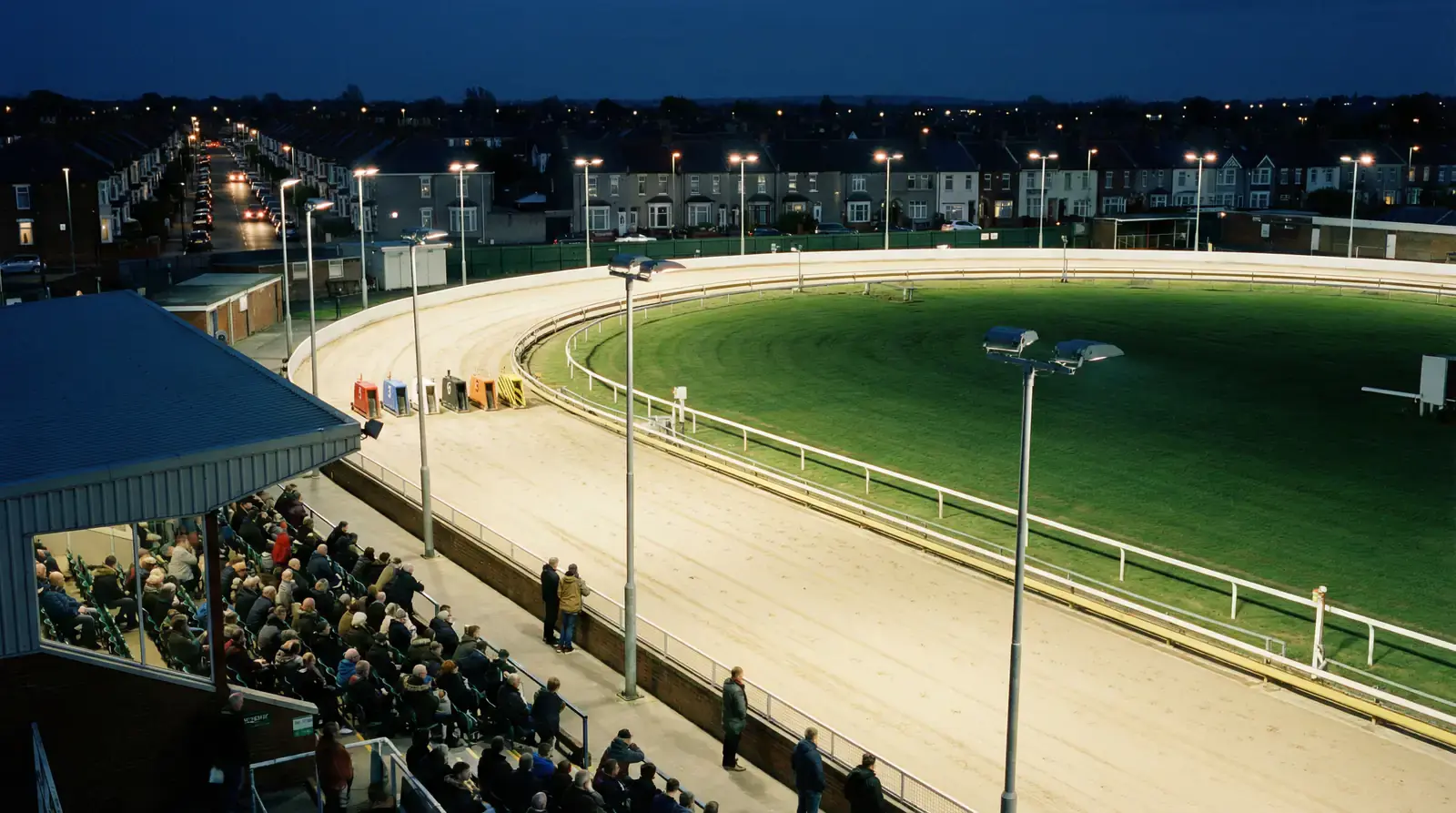
Romford
Circumference: 350m. Sprint-focused. Tight bends, short run-in. Trap 1 bias strong. Suits railers and early-pace dogs. BAGS daytime cards plus evening meetings. London's go-to venue for greyhound bettors.
Towcester
Circumference: 420m. Galloping track. Sweeping bends, long home straight. Less trap bias than tight circuits. Suits stamina runners and strong finishers. Home of the English Greyhound Derby. Premium-quality open-race venue.
Turning Results Into an Edge: Practical Strategy
An edge does not come from one result — it comes from reading a hundred of them the right way. Strategy in greyhound betting is not about systems, secrets, or tipster subscriptions. It is about building a disciplined process: record results, identify patterns, set rules for when you bet and how much, and review what happened. The bettors who last longest are rarely the ones with the most dramatic wins — they are the ones with the most consistent approach.
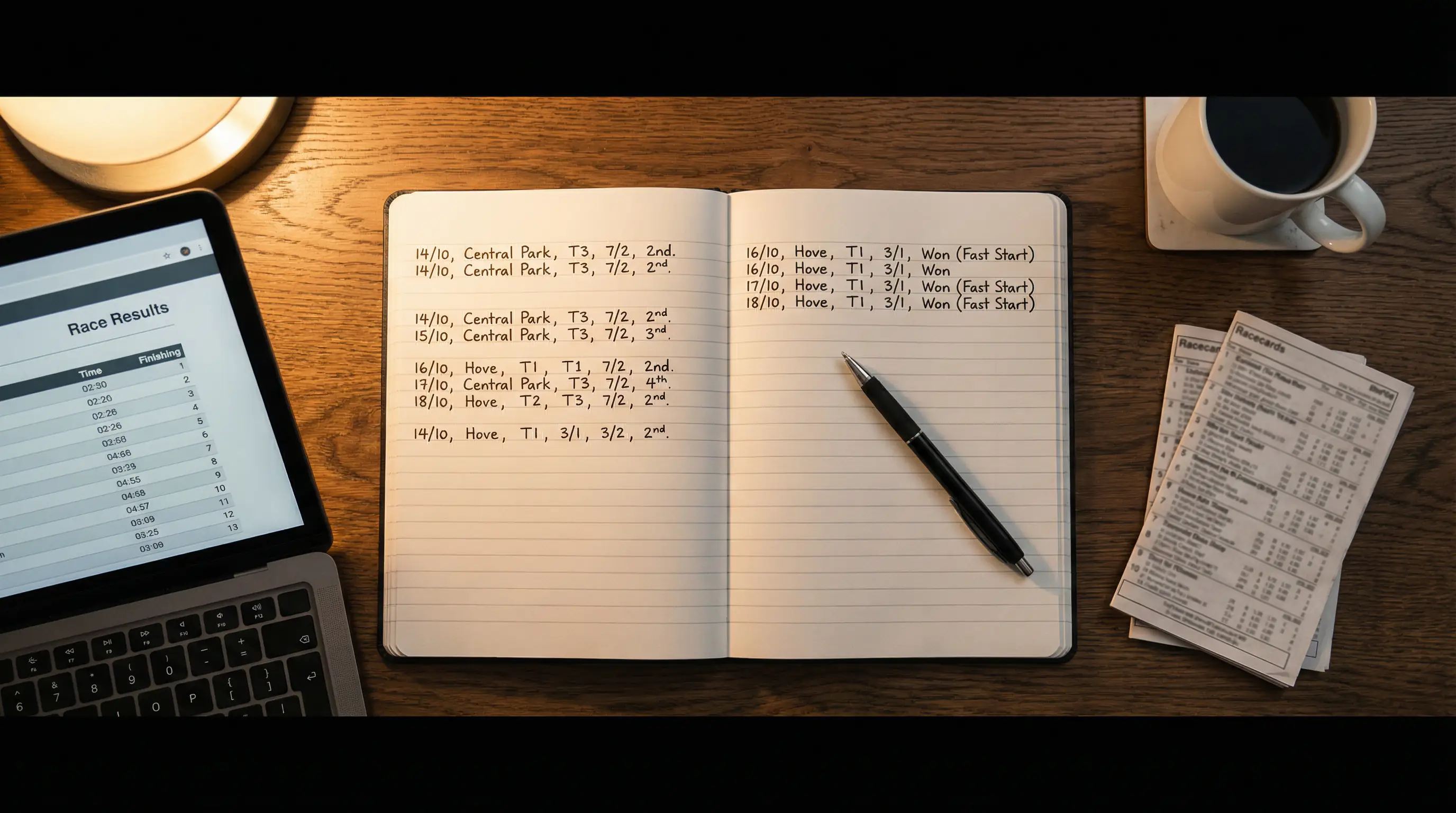
The first step is record-keeping. Every bet you place should be logged with the date, track, race, dog, trap, bet type, stake, odds, and outcome. Over time, this log becomes your most valuable tool, because it reveals your own patterns — which tracks you bet well at, which bet types generate profit, and which habits cost you money.
The second step is pattern recognition. After accumulating a sample of results — at least fifty to a hundred races at a specific track — you start to see recurring themes. Maybe trap 1 at Sunderland is winning at 22% over sprints, while the market typically prices trap 1 dogs as though the win rate is closer to 17%. That gap between actual performance and market expectation is where value lives.
The third step is staking discipline. Set a bankroll — an amount you are prepared to allocate to greyhound betting and prepared to lose entirely. Divide it into units. A common approach is to risk 1-2% of the bankroll per bet. This sounds conservative, and it is meant to be. The variance in greyhound racing is high: six-dog fields with short runs and tight margins produce volatile results. Flat staking — the same unit on every bet — protects you from the temptation to chase losses with larger bets after a bad run.
The fourth step is review. At the end of each week or month, calculate your return on investment. Identify which selections were based on sound reasoning and which were impulse bets. If your forecast bets are profitable at certain tracks but not others, concentrate on the tracks where your analysis works. The review loop is what turns a hobby into a craft.
Do
- Check calculated times rather than raw times when comparing form across different days.
- Cross-reference trap draw with the dog's running style and the track's known biases.
- Set a session limit in advance — both a loss limit and a time limit.
- Record every bet, including the reasoning behind each selection.
Don't
- Chase losses by increasing stakes after a bad run of results.
- Ignore going conditions when a dog's form appears inconsistent.
- Back a dog based on its name, its trap colour, or because it won last time without checking the context.
- Assume form from one track transfers directly to another without accounting for track characteristics.
How to Identify Value in Greyhound Betting Markets
Value is not a cheap price — it is a price that underestimates probability. If your form analysis tells you a dog has a 30% chance of winning and the bookmaker's odds imply only a 20% chance, you have found value regardless of whether the dog is priced at 3/1 or 7/2. The price matters only in relation to the probability.
Estimating probability in greyhound racing is simpler than in many other sports because the variables are constrained. Six runners, one distance, one track, one set of conditions. Start with calculated times across the last three runs and rank the six dogs by average adjusted speed. Factor in trap draw suitability and running style. Note any remarks that suggest recent bad luck or, conversely, flattered form. The dog you arrive at as the likely winner may not be the favourite — and that is where the opportunity sits.
A practical method: convert the bookmaker's odds to implied probability. At 3/1, the implied probability is 25%. At 7/2, it is approximately 22%. If your own assessment of the dog's winning chance is significantly higher than the bookmaker's implied probability — by at least five percentage points — you have a value bet. Not every value bet wins. The point is that over a large enough sample, backing value consistently produces a positive return, while backing short-priced favourites without assessing probability does not.
The January 2026 GBGB rule amendments introduced a requirement for Local Stewards to publish reasons for all withdrawals, which adds transparency to the non-runner process. For value bettors, this is useful because understanding why a dog was withdrawn — injury, kennelling issue, late scratch — helps you assess whether the remaining field has been weakened or strengthened in ways the market has not yet fully adjusted for.
Results are a rearview mirror with a compass built in — they show where dogs have been and hint at where they are heading.
Betting Smart, Not Just Betting More
There is a line between disciplined betting and chasing — know which side you are on. Greyhound racing, with its rapid-fire schedule of races every fifteen minutes across multiple tracks, is specifically designed to offer constant opportunity. That same frequency can become a trap for bettors who do not set boundaries before they start.
Bankroll management is not optional — it is the foundation everything else sits on. Decide before any session how much you are prepared to lose. Not how much you hope to win: how much you are prepared to lose. Write the number down. When you hit it, stop. This applies to daily sessions, weekly totals, and monthly totals. The moment you start treating your loss limit as a suggestion rather than a rule, you have crossed from betting to chasing.
Time limits matter as much as money limits. A four-hour session watching fast results cycle through on your phone erodes decision quality. Fatigue, frustration after a few losing bets, and the false conviction that you are "due a winner" all compound over a long session. Set a time limit alongside your financial one. Some bookmakers allow you to configure session time reminders and deposit limits directly in your account settings — use them.
If you find that you are thinking about your next bet when you are not betting, increasing your stakes to recover losses, or feeling agitated when you cannot bet, those are warning signs that the activity has moved beyond recreation. Recognising these patterns early is not weakness — it is the same kind of analytical discipline this entire guide advocates, applied to yourself instead of a racecard.
Support and self-exclusion resources
If you or someone you know is struggling with gambling, help is available. GambleAware offers free advice, support, and information. The National Gambling Helpline can be reached on 0808 8020 133, open 24 hours a day. GamStop is the UK's free self-exclusion scheme that allows you to block yourself from all licensed online gambling operators for a period of your choosing. You can also speak to your bookmaker directly about setting deposit limits, loss limits, or self-exclusion from their platform.
Greyhound Results FAQ
What do the abbreviations on a greyhound result card mean?
Greyhound result cards use shorthand codes to describe how each dog ran. The most common abbreviations include QAw (quick away from traps), SAw (slow away), EP (early pace), Ld followed by a bend number (led from that point), Bmp (bumped by another runner), Crd (crowded for room), EvCh (every chance — a clear run), RanOn (finished strongly), ALd (led for all or most of the race), and positional codes like Rls (ran on the rails), Mid (ran in the middle), and Wide (ran wide). These codes appear alongside the finishing position and time, and they provide essential context for understanding why a dog finished where it did rather than just where it placed.
How do forecast and tricast returns appear in greyhound results?
Forecast and tricast dividends are declared at the bottom of each race result, expressed as a return to a £1 unit stake. The forecast dividend covers the first two dogs in the correct finishing order, while the tricast covers the first three. These dividends are pool-based, calculated from the total money staked into the respective pools after deductions. A low forecast dividend suggests the market expected that finishing order; a high one indicates a surprise result. Dividends vary significantly between meetings depending on pool size — busier evening meetings tend to produce more stable dividends than quieter daytime BAGS cards with smaller pools.
What is the difference between fast results and full results in greyhound racing?
Fast results show the essential outcome of a race: the finishing order, each dog's starting price, the winning time, and the forecast and tricast dividends. They are designed for quick confirmation during a live betting session. Full results include everything in the fast results plus sectional times, bend positions, detailed race remarks from the judge, going allowance, and calculated times. Full results are what you need for proper form analysis, because they explain how and why the race unfolded the way it did — not just the final outcome. Most results portals like Sporting Life and Timeform publish fast results first, with full results following shortly after as race officials finalise the detailed record.
The Last Trap: What Results Won't Tell You
Results show you what happened on the sand — they do not show you the dog that found something new on a Thursday trial. They do not capture the trainer who has quietly switched feeding routines, the dog that has matured physically over the winter, or the kennel that has been travelling its best runner to an unfamiliar track for practice runs that never appear in the public form book. Results are the evidence that is visible. The invisible part — preparation, intent, timing — is what separates good bettors from great ones.
No amount of data will eliminate uncertainty. Greyhound racing is a live sport with six animals running at forty miles an hour around bends, and the margin between first and fourth is often less than a second. A stumble at the first bend, a moment of interference, a dog that simply decides to look at the hare differently tonight — these are the unquantifiable variables that make every race a fresh event, regardless of what the form says should happen.
The best bettors understand this. They use results as the foundation of their analysis, not the totality of it. They watch replays. They note how a dog moves, not just where it finishes. They pay attention to trainers who consistently improve dogs through the grades and tracks where certain kennels have strong records. They combine the numbers with observation, and they accept that even after all of that, the traps open and anything can happen.
That acceptance is not a weakness in the method. It is the method. Results give you the best available picture of probability, and probability is all you are ever betting on. Treat the data with respect, apply it with discipline, and understand that the last trap — the one you cannot see — is always part of the race.
