 Available in US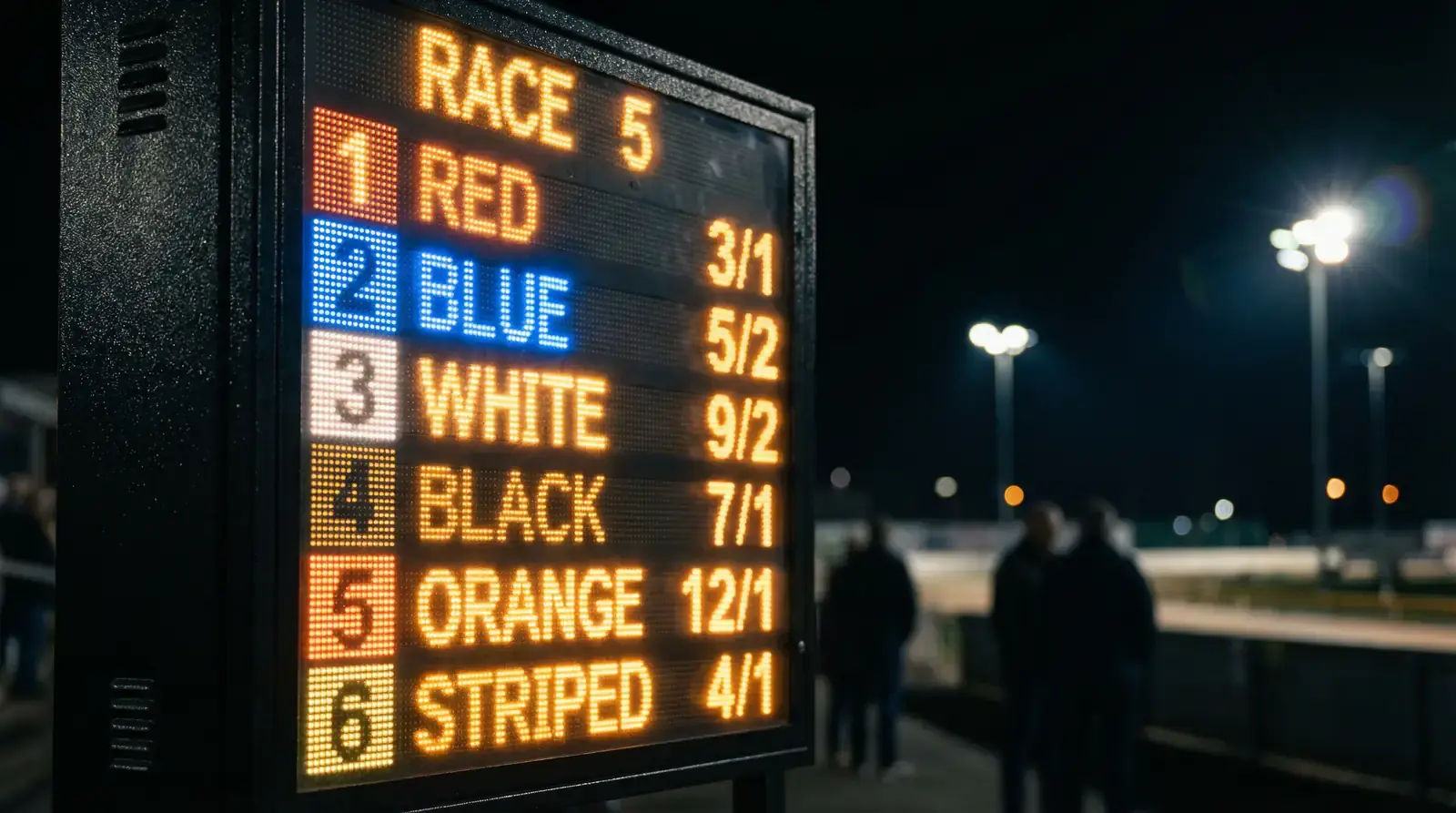
Odds Are Opinions Expressed in Numbers
Every greyhound price is someone’s estimate of probability — and most estimates are wrong. Not wildly wrong, usually. The market does a reasonable job of sorting favourites from outsiders, strong dogs from weak ones. But in the margins — in the gap between what the odds imply and what the form actually suggests — there’s space. That space is where profitable greyhound betting lives.
Understanding odds is not the same as understanding form. You can read a racecard expertly and still lose money if you don’t know whether the price being offered represents value or not. A dog might be the most likely winner in a six-runner race, but if the odds are too short — if the bookmaker’s price implies a higher probability than the dog’s true chance — backing it is a losing proposition over time, even if it wins tonight.
This guide covers how greyhound odds are created, why they move, what starting price really means, how Best Odds Guaranteed works, and — most importantly — how to identify value. We’ll also look at the difference between bookmaker and exchange odds, how to compare prices across operators, and what price movements can tell you before a race begins. The goal is to make you as literate in odds as you are in form, because both skills are necessary and neither is sufficient on its own.
How Greyhound Odds Are Set and Why They Move
Odds start with the bookmaker’s tissue and end with the weight of public money. The process begins before the race appears on screen. A bookmaker’s trader — or, increasingly, an automated pricing model — creates a tissue price for each dog based on the form, the draw, the grade and the track. This tissue is the bookmaker’s initial estimate of each dog’s chances, expressed as odds, and it includes a margin (the overround) that ensures the book is profitable regardless of the outcome.
The tissue is not the final price. Once the market opens, real money starts flowing. Punters back their selections, and the weight of that money adjusts the odds. If a disproportionate amount of money lands on one dog, the bookmaker shortens its price (reducing the odds, which implies a higher chance of winning) and typically drifts one or more other dogs to rebalance the book. This is price discovery — the market collectively deciding, through bets, what each dog’s chances are worth.
In greyhound racing, this process happens fast. Races are often priced up only fifteen to twenty minutes before the off, and the bulk of the money arrives in the final few minutes. The early price can be significantly different from the starting price, which makes the timing of your bet an active decision rather than a formality. Bet early, and you might lock in a generous price before the market corrects — or you might take a price that shortens further, suggesting the market knows something you don’t. Bet late, and you get the most informed price but sacrifice any advantage from moving before the crowd.
The overround — the bookmaker’s built-in margin — is worth understanding because it directly affects the value available to you. In a perfectly fair market with six runners, the implied probabilities of all six dogs would sum to exactly 100%. In practice, the bookmaker’s book sums to between 115% and 130%, depending on the operator and the market. That extra percentage is the house edge. It means that even if you could predict the exact probability of every outcome, you’d still need to find prices that exceed the true probability by at least the margin embedded in the odds. The lower the overround, the less margin you need to overcome, which is one reason why odds comparison matters.
For BAGS races and lower-profile meetings, bookmaker margins tend to be wider because the market receives less scrutiny and less money. For bigger evening cards and feature races, margins often tighten because more operators compete for betting volume and more informed money is in play. Knowing which type of meeting you’re betting on helps calibrate your expectations about the value available in the market.
Starting Price in Greyhound Racing: The Full Picture
SP is not the “real” price — it’s the price at the moment that matters most. The starting price is the final set of odds available on each runner at the instant the traps open. In UK greyhound racing, SP is typically derived from the on-course Tote pool or from industry-standard pricing mechanisms used for BAGS and SIS races, rather than from on-course bookmaker boards as in horse racing.
For many greyhound bettors, SP is the default. They place their bet at SP because the final price hasn’t been determined when they commit, or because they’re betting in a shop where SP is the standard settlement basis. The advantage of betting at SP is that you get the market’s final assessment — the price that incorporates all available information, including any late money from informed sources. The disadvantage is that you have no control over what that price turns out to be.
SP becomes a reference point even for bettors who take an early price. If you backed a dog at 5/1 and the SP was 3/1, you got value — the market moved to give the dog a shorter price after you’d already locked in, meaning your price implied a lower chance than the final market consensus. If SP was 7/1, the market moved the other way, and the smart money drifted your selection out. Neither outcome tells you whether the dog will win, but over hundreds of bets, consistently taking prices above SP is a strong indicator of value-finding skill.
Recording the SP alongside your bet price is one of the simplest and most revealing habits a greyhound bettor can develop. It turns every bet into a data point about your pricing accuracy, and over time, the pattern tells you whether you’re ahead of the market or behind it.
Best Odds Guaranteed: What It Means and Who Offers It
BOG turns the SP question from a gamble into a guarantee. Best Odds Guaranteed is a promotion offered by many UK bookmakers on greyhound racing — and on horse racing — where you’re paid at whichever is higher: the price you took when you placed your bet, or the starting price. It eliminates the risk of taking an early price that turns out to be worse than SP.
Here’s the practical effect. You back a dog at 4/1 in the morning market. By race time, it’s been backed down to 3/1 SP. Without BOG, you’d have been paid at your original 4/1 regardless — which is fine, because you took the better price. But suppose the opposite happens: you take 4/1, and the dog drifts to 6/1 SP. Without BOG, you’re stuck at 4/1 and have missed the better price. With BOG, you’d be paid at 6/1 — the higher of the two. It’s a one-way ratchet in your favour.
Not all bookmakers offer BOG on greyhounds, and those that do may apply conditions — minimum odds, maximum payout, specific meeting types, or restrictions to certain platforms (online only, not in shops). The terms change regularly, so checking the current offer before betting is essential. But where BOG is available and applies to your bet, it’s one of the few genuinely bettor-friendly promotions in the market. It costs the bookmaker money on average, which is why the conditions exist, but for the individual bettor it removes the downside of price timing.
The strategic implication is that when BOG is in play, taking early prices becomes more attractive. You capture any pre-market value with no risk of being caught by a drift. Without BOG, taking an early price is a judgment call about whether the price will shorten or lengthen. With it, you can take the early price and know that if the market moves against you, you’ll still get SP. It’s a meaningful structural advantage when available.
Bookmaker Odds vs Exchange Odds
Exchange odds strip out the bookmaker margin — but they come with their own cost. Betting exchanges like Betfair operate on a different model from traditional bookmakers. Instead of a bookmaker setting the odds and taking the risk, the exchange matches bettors against each other. One person backs a dog to win; another lays it (betting it won’t win). The exchange takes a commission on winning bets — on Betfair, the base rate ranges from 2% to 9% depending on the rewards package selected — rather than building a margin into the odds.
The result is that exchange odds are usually better than bookmaker odds, particularly on favourites. Where a bookmaker might price a dog at 2/1 (implying a 33% chance, with margin), the exchange might offer 2.2/1 (decimal 3.2) for the same dog, reflecting a closer-to-true probability with less margin. Over time, the difference in prices compounds into a significant advantage for bettors using exchanges — provided the liquidity is there.
Liquidity is the catch. Greyhound markets on exchanges are thinner than horse racing markets. Popular evening races attract reasonable volume, but BAGS meetings and lower-profile cards may have very little money in the exchange market, meaning you can’t always get matched at the price you want, or you can only get a fraction of your desired stake matched. In a fast-moving greyhound market where races arrive every ten minutes, waiting for a match that never comes is a real limitation.
Exchange betting also enables laying — betting that a dog won’t win. This opens up strategic possibilities that traditional bookmakers don’t offer, including in-play trading (backing at a higher price and laying at a lower one to lock in profit regardless of the result). These techniques are more advanced and more common in horse racing, but they exist in greyhound markets for bettors willing to learn. The key constraint remains liquidity: you need someone on the other side of your bet, and in greyhound racing, that someone isn’t always there.
What Value Means in Greyhound Markets
Value isn’t about finding a winner — it’s about finding a winner whose price is wrong. This distinction is the single most important concept in profitable betting, and it’s the one that most bettors never fully internalise. A dog at 6/1 that wins is not automatically a value bet. A dog at 6/1 whose true chance of winning was 20% (fair odds of 4/1) was a value bet, because the price was bigger than the probability warranted. A dog at 6/1 whose true chance was 10% (fair odds of 9/1) was poor value, even though it won — because over many similar bets, you’d lose money backing 10% chances at 6/1.
The challenge is that nobody knows a dog’s “true” probability. Probability in greyhound racing isn’t a fixed number — it’s an estimate derived from form, draw, track conditions, going and the competitive profile of the race. Your job as a bettor is to make that estimate better than the market’s estimate, or at least different from it in ways that prove profitable over time.
Value appears in greyhound markets more often than in horse racing markets, for a structural reason: greyhound races attract less analytical attention. The big-race horse markets are pored over by thousands of informed bettors, professional punters and syndicate operations. Greyhound markets — especially BAGS races and lower-grade evening cards — receive a fraction of that scrutiny. The prices are set primarily by bookmaker algorithms and adjusted by the flow of largely recreational money. There’s more room for a prepared bettor to find mispricing.
The practical approach to finding value is simple in concept and demanding in execution. For each race, estimate the chance of your selection winning based on your form analysis. Convert that estimate to fair odds. Compare the fair odds to the available price. If the available price is higher than your fair odds, you have a value bet. If it’s lower, you don’t, regardless of how strongly you feel about the dog. This discipline — refusing to bet when the price doesn’t justify the risk — is what separates value bettors from punters who simply pick winners.
You won’t get the estimates right every time. The point isn’t precision — it’s directionality. If you’re consistently estimating probabilities more accurately than the market, the prices you take will, across a large enough sample, return more than you stake. That’s value, and it’s the only sustainable basis for profitable greyhound betting.
How to Calculate Implied Probability from Greyhound Odds
4/1 means the market gives this dog a 20% chance — your job is to decide if the real chance is higher. The conversion is straightforward. For fractional odds of A/B, the implied probability is B divided by (A + B), multiplied by 100. So 4/1 gives you 1 / (4 + 1) = 0.20, or 20%. At 2/1, it’s 1 / 3 = 33.3%. At 6/4, it’s 4 / (6 + 4) = 40%. Evens (1/1) implies a 50% chance.
In decimal odds, which are common on exchanges and some online platforms, the conversion is even simpler: divide 1 by the decimal odds and multiply by 100. Decimal 5.0 (equivalent to 4/1) gives 1 / 5.0 = 20%. Decimal 3.0 (2/1) gives 33.3%.
Remember that these implied probabilities include the bookmaker’s margin. The true probabilities of all outcomes in a fair market sum to 100%, but the bookmaker’s implied probabilities will sum to more — often well above 110%, sometimes past 125%. To get a truer sense of each dog’s market-implied chance, you can normalise by dividing each dog’s implied probability by the total. But for practical value-finding, comparing your own probability estimate against the raw implied probability from the odds is usually sufficient. If you think a dog has a 25% chance and the odds imply 20%, that’s a value gap worth exploiting.
Comparing Odds Across Bookmakers: Where to Look
Five minutes of price comparison can change the return on a winning bet by 15%. Greyhound odds vary between bookmakers — sometimes slightly, sometimes significantly. Two operators might price the same dog at 3/1 and 7/2 respectively. On a ten-pound stake, that’s the difference between a thirty-pound return and a thirty-five-pound return. Over hundreds of bets, consistently taking the best available price adds up to a material improvement in your overall results.
Oddschecker is the most widely used odds comparison tool for UK greyhound racing. It aggregates prices from major bookmakers in real time, letting you see at a glance who’s offering the best odds on each runner. The interface is straightforward: select the track and race, and the prices are laid out side by side. For bettors with accounts at multiple bookmakers — which is standard practice for anyone serious about finding value — this is the fastest way to ensure you’re not leaving money on the table.
The practical barrier is time. Greyhound races come thick and fast, especially during BAGS meetings, and checking odds across six or seven bookmakers for every race is impractical. A more realistic approach is to have two or three bookmaker accounts open alongside an odds comparison site and to check the best price for your selection before committing. Even a quick glance — ten seconds to confirm you’re getting the best available odds — can make a meaningful difference across a betting week.
Price comparison also reveals which bookmakers consistently offer competitive greyhound odds. Some operators treat greyhound racing as a secondary product and price it lazily with wide margins. Others compete actively on greyhound prices, particularly on evening cards and feature meetings. Over time, you’ll develop a sense for which operators to check first, and that efficiency compounds into better average returns.
What Price Movements Tell You Before a Race
A drifting price isn’t always bad news — and a shortening price isn’t always right. Price movements in the minutes before a greyhound race carry information, but interpreting that information requires nuance rather than reflexive reaction.
When a dog’s price shortens significantly — say from 5/1 to 3/1 in the last five minutes — it means money has arrived. That money might come from informed sources: connections, kennel followers, or professional bettors who have information or analysis suggesting the dog is better than the market initially priced. Or it might come from a wave of recreational bettors who liked the look of the dog’s form or simply followed a tipping service. Both produce the same price movement, but only one carries genuine informational weight.
When a dog drifts — its price lengthening from 3/1 to 5/1 — the market is losing confidence. Again, the reasons vary. Perhaps the dog was overbet early by uninformed money and the bookmaker has corrected the price. Perhaps informed money has arrived on another dog in the race, causing the book to rebalance. Or perhaps someone with inside knowledge — a trainer connection, a track regular — has decided not to back it, and the absence of expected money has let the price go.
The useful approach is to watch the market as a whole, not just one dog’s price. If one dog shortens sharply while the rest drift uniformly, the market is telling you that money is concentrating on a single selection. If two dogs shorten while a third drifts hard, the race might be more competitive than the form suggested, with informed opinion split. If nothing moves much, the form is being read the same way by everyone and the prices are relatively stable — which means value, if it exists, is marginal.
Price movements are most informative in races where the market has had time to form — evening cards and higher-grade races. In BAGS meetings, where the pricing window is short and the volume is lower, movements can be more erratic and less reliably informative. Use them as one input among many, not as a substitute for your own analysis.
The Price Was Right — Until the Traps Opened
Markets process information — they don’t process surprise. The odds on a greyhound race represent the market’s best collective estimate of each dog’s chances, given everything that’s known before the traps open. They incorporate form, draw, going, trainer patterns and the weight of money. What they can’t incorporate is what happens on the track: the stumble at the start, the bump at the second bend, the dog that finds something extra on a Thursday night that the form never suggested.
That’s the fundamental tension in odds-based betting. You can do everything right — analyse the form, calculate the probability, find the value price, take it early with BOG in play — and still lose, because the race doesn’t follow the script. The price was correct in the sense that it represented the best available information. It was wrong in the sense that the information wasn’t complete, because it never can be.
Profitable betting doesn’t require you to be right about every race. It requires you to be right about the odds — to consistently take prices that are larger than the true probability justifies. Do that across enough bets, and the mathematics works in your favour regardless of individual results. The price is your edge. The race is just where you find out whether the edge paid off this time.
