Best Greyhound Betting Sites – Bet on Greyhounds in 2026
Loading...
Twenty Tracks, Each With Its Own Character
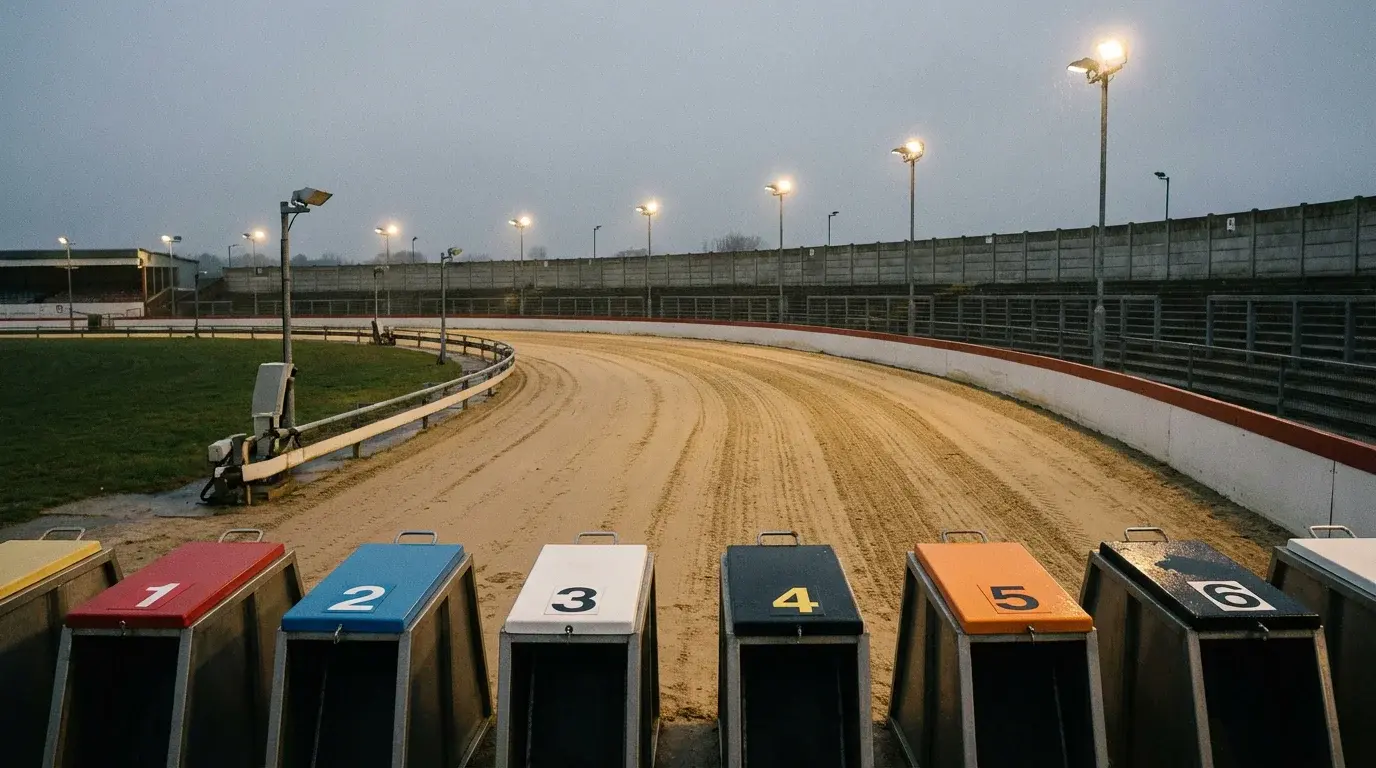
Not all UK greyhound tracks are equal — and the differences matter to your betting. There are eighteen GBGB-licensed greyhound stadiums operating across England, Scotland and Wales, each with its own circuit dimensions, sand surface, trap geometry and racing programme. A dog that dominates at one venue can look ordinary at another, not because it has suddenly lost ability, but because the track itself has changed the terms of the race.
Most bettors treat tracks as interchangeable backdrops. They check the form, note the times, pick a dog, and give no thought to whether the circuit favours inside runners, whether the first bend is ten metres closer to the traps than at the dog’s usual venue, or whether the sand rides differently after rain. That’s a mistake. Track knowledge is one of the cheapest edges available in greyhound betting — it costs nothing but attention, and it pays back in selections that account for variables other punters are ignoring.
This guide maps the UK greyhound track circuit as it stands in 2026. We’ll cover the major venues in detail, survey the smaller tracks worth knowing, and explain how design features like circumference, bend tightness and trap position feed directly into race outcomes and betting decisions. Think of it as the geographical layer of your form analysis — the one that sits underneath everything else.
How Track Design Affects Race Outcomes
Circumference, bend radius and distance to the first turn — these aren’t cosmetic details. They’re structural variables that determine how a greyhound race unfolds, and understanding them is the first step toward using track knowledge in your betting.
Circumference dictates how much ground a dog covers per lap. Smaller circuits mean tighter bends and shorter straights. Dogs with raw speed but poor cornering tend to lose ground on tight bends and can’t recover on short run-ins. Larger circuits give wide-running dogs more room to operate and reduce the advantage that inside-drawn railers hold at compact venues. When you see a dog’s form at a small, tight track and try to project it onto a bigger, more galloping circuit, you need to adjust your expectations — and vice versa.
The distance from the traps to the first bend is arguably the single most important design variable in greyhound racing. At tracks where the first bend arrives quickly — within 50 to 70 metres of the start — early pace and trap draw are magnified. A dog breaking slowly from trap 6 at a track with a short run to the first turn is in immediate trouble: it has to cross the paths of five other dogs while the bend is already arriving. At venues with a longer run-in, there’s more time for positions to settle before the first bend, and the draw becomes less decisive.
Bend radius affects how much dogs are forced to check their stride. Tighter bends slow all runners, but they particularly disadvantage wide-running dogs that have to cover more ground. At tracks with sweeping bends, the difference between the inside and outside path is smaller, and the speed penalty for running wide is reduced. This feeds directly into trap statistics — tracks with tight bends tend to have a stronger bias toward low trap numbers, while tracks with gentler geometry distribute wins more evenly across traps.
The surface itself varies between venues. All UK greyhound tracks use sand, but the composition, drainage and maintenance regimes differ. Some tracks ride consistently; others change character noticeably between the start of a meeting and the end, or between dry weather and wet. The going allowance captures some of this variation, but not all of it. Experienced bettors who follow specific tracks develop an instinct for how the surface behaves under different conditions — and that instinct comes from paying attention to the venue, not just the dogs.
The Major UK Greyhound Venues
These are the tracks that generate the most racing, the most data, and the most betting action. They host the busiest schedules, attract the strongest fields, and produce the deepest form records. If you’re betting on greyhounds regularly in the UK, you’ll encounter these venues more often than any others, and knowing their characteristics gives you a structural advantage that builds with every meeting you study.
The profiles below cover the essential details for each venue: circuit size, key distances, trap tendencies and the general character of the racing. This isn’t an exhaustive history — it’s a bettor’s briefing on the tracks that matter most.
Romford: The Sprint Capital
Fast, tight, and heavily backed by evening punters. Romford is a compact circuit in east London with a relatively short run to the first bend, which makes trap draw critically important. Sprint races over 225m and 400m are the bread and butter, and inside traps — particularly trap 1 — have a well-documented statistical edge. The track hosts regular evening cards that draw strong fields and significant betting volume, making it one of the highest-profile venues in the licensed circuit.
For bettors, Romford rewards early-pace analysis. Dogs that break quickly and rail to the front have a distinct advantage because the tight bends punish wide runners. If you’re studying Romford form, the first-bend split time and the trap number are the two data points that deserve the most weight. A dog with quick away remarks from an inside trap is in its element here; the same dog drawn in trap 6 faces a genuinely different proposition.
Towcester: Distance and Variety
The Derby venue — and a track that rewards staying power. Towcester in Northamptonshire is among the largest circuits in UK greyhound racing, with a wide variety of distances available including some of the longest trips in the sport. The more generous circumference means bends are less punishing, the run to the first turn is longer, and the draw has less influence on outcomes than at tighter tracks.
Towcester’s character favours stamina-oriented dogs and strong finishers. The longer straights give closers time to reel in early leaders, and the extra distance in stayers’ events rewards dogs with genuine endurance. When analysing Towcester form, calculated times over the specific distance are more useful than raw speed figures, and dogs with strong late-race remarks — RnOn, FnsWl — deserve more attention here than at sprint-oriented venues.
Monmore Green: Consistent and Competitive
Midlands racing at its most regular. Monmore Green in Wolverhampton runs one of the busiest schedules in UK greyhound racing, hosting both BAGS afternoon cards and evening meetings with reliable frequency. The circuit is medium-sized, offering a good balance between inside-draw advantage and galloping room, and the standard distances produce competitive, form-readable racing.
The regularity of Monmore’s programme is a quiet advantage for form students. Dogs race frequently at the venue, building deep form records that can be compared directly — same track, same distances, often similar going conditions. For bettors who specialise, Monmore offers a volume of data that few other tracks match. Trainer patterns are particularly visible here because many local kennels run their dogs week after week at the same venue, creating trackable sequences that reward consistent attention.
Regional and Smaller UK Tracks
The smaller circuits get less attention — which is precisely where opportunities hide. Beyond the marquee venues, the UK greyhound circuit includes a spread of regional tracks that host regular racing, generate reliable form data, and attract less public scrutiny than the big evening cards. For bettors willing to do their homework, these tracks can offer situations where the market hasn’t fully priced in the local nuances.
Nottingham is a medium-to-large track with a strong racing programme, a good variety of distances and competitive fields across most grades. It draws significant evening card attention but also runs productive afternoon BAGS meetings. The circuit’s dimensions give a relatively balanced trap draw, though inside traps still hold a marginal edge at sprint distances. Nottingham form tends to be reliable — dogs that perform consistently here are usually genuine, and the depth of the programme means you can build substantial form records for regular runners.
Swindon was a compact circuit in the south-west with a brisk racing schedule until its closure in December 2025. Dunstall Park in Wolverhampton, which replaced Perry Barr, has a mid-sized circuit that produces honest racing across a range of distances — it’s a venue where middle-distance dogs with clean running styles tend to perform to their marks.
Sheffield runs a busy programme and has a reputation for competitive cards, particularly in the middle grades. The circuit is large enough to give galloping dogs room to operate, but the bends are sharp enough to punish sloppy cornering. Harlow in Essex is a compact, fast track where trap draw and early pace dominate, making it a natural study for bettors interested in sprint-biased venues.
Harlow and Central Park each have their own dimensions, their own trap biases and their own going characteristics. Harlow is compact and fast. Central Park provides solid mid-week racing with a form book that rewards regular attention. The opening of Dunstall Park Greyhound Stadium in Wolverhampton in September 2025 — replacing the closed Perry Barr — added a modern, purpose-built venue to the licensed circuit. None of these tracks generates the headline coverage of a Romford evening card, but each produces races where local knowledge translates into betting edge.
The key point for bettors is that track familiarity compounds. Following two or three smaller tracks closely will, over months, give you a feel for how the surface rides, which trainers are in form, which traps win at which distances, and how the going changes through a meeting. That local knowledge is worth more than a superficial scan of every track in the country. Specialists outperform generalists in greyhound betting more than in almost any other form of racing, and the regional tracks are where that specialism pays off most clearly.
Independent statistics services like Greyhound Stats and data provided through platforms such as Timeform make it possible to study these venues even if you never visit them in person. Trap win percentages, trainer strike rates and calculated time comparisons are all available for the committed researcher. The data exists — the question is whether you’re willing to use it. But knowing the track is only half the picture. When you race there matters almost as much as where.
BAGS Meetings vs Evening Cards: What Bettors Need to Know
Daytime and evening racing serve different purposes — and different betting approaches. BAGS (Bookmakers’ Afternoon Greyhound Service) meetings are funded by the bookmaking industry to provide content for betting shops and online sportsbooks during the day. They run at regular intervals, typically from late morning through to mid-afternoon, and provide the bulk of greyhound racing activity in the UK by volume. Evening cards are independently promoted meetings, often with stronger fields, higher grades and bigger prizes.
The distinction matters because the competitive profile of a BAGS card is often different from an evening meeting at the same track. BAGS races tend to feature lower grades and more predictable fields, partly because the programme exists primarily to generate betting content rather than to showcase elite racing. Evening cards attract open races, higher-graded events and more ambitious entries from leading trainers. The dogs are, on average, faster and the races more competitive.
For bettors, BAGS meetings offer quantity and regularity. You can watch racing almost every day, accumulate form data rapidly, and find situations where the market hasn’t fully priced in a dog’s recent improvement or a trainer’s quiet run of form. The downside is that lower-grade racing can be more erratic — less-established dogs are more likely to produce inconsistent efforts, and the form lines can be harder to trust.
Evening cards offer quality and atmosphere. The bigger races attract more serious analysis from both bettors and bookmakers, meaning the market tends to be more efficient. Finding value at an evening open race is harder than spotting an edge in a Tuesday afternoon A7. But when you do find it, the price is often more meaningful because the market has priced the race with more care. Knowing which type of meeting you’re betting on — and adjusting your expectations and approach accordingly — is a basic piece of track literacy that too many punters overlook.
Track-Specific Trap Statistics
Trap 1 doesn’t win at the same rate everywhere. This is one of the most useful facts in greyhound betting, and it’s one that separates track-literate bettors from the rest. Every UK venue has its own trap bias — a statistical tendency for certain traps to produce more winners than others — and that bias is a direct product of the track’s design.
At compact tracks with a short run to the first bend, trap 1 typically wins more often than the statistical average because the inside dog has the shortest route to the rail. The advantage can be significant: at some sprint distances, trap 1 wins 20% or more of all races, well above the 16.7% you’d expect in a balanced six-dog field. Trap 6, the widest draw, often sits below average at these venues, particularly over shorter trips where there’s no time to recover from a wide first bend.
At larger tracks with more generous run-ups and wider bends, the distribution is more even. Trap 4 and trap 5 can outperform expectations at some venues because they get a clean run on the outside of the inside pack while avoiding the squeeze that sometimes affects the middle traps. The specific numbers vary by track and by distance, and they shift over time as track maintenance, rail placement and racing programmes change.
The practical application is straightforward. Before backing a dog, check the trap statistics for that specific track at that specific distance. If you’re considering a dog drawn in trap 6 at a tight sprint track where trap 6 wins only 12% of races, you need the form to be very strong to overcome that structural disadvantage. If your selection is drawn in a high-performing trap, the track’s geometry is working in its favour before the race even begins.
Updated trap statistics are available from services including Greyhound Stats and the statistical sections of platforms like Timeform. The data is broken down by track, distance and time period, allowing you to see current trends rather than historical averages that may have shifted. Using this data doesn’t guarantee winners, but it adds a layer of context that raw form analysis alone misses. The track is not a neutral venue — it’s an active participant in the race, and the trap statistics are the scoreboard that proves it.
Race Distances at UK Tracks: A Quick Reference
Sprint, middle, stay, marathon — every track offers a different mix. Understanding the distance categories and which tracks host them helps you evaluate whether a dog’s form is relevant to tonight’s race or whether it has been running under different conditions.
Sprint races cover distances from around 210m to 285m. These are pure speed tests — over in under seventeen seconds, decided in the first few strides and around the first bend. Romford and Harlow are among the tracks that run regular sprint programmes. At sprint distances, early pace and trap draw overwhelm most other form variables.
Standard or middle distances — roughly 400m to 500m — are the backbone of UK greyhound racing. Most graded races, most BAGS races and most evening cards are built around distances in this range. Every licensed track offers at least one standard-distance race, and many offer two or three different trips within the category. This is where all-round form matters: early pace, bend work, stamina and finishing speed all play a role.
Stayers’ races typically cover 630m to 700m and appear less frequently on the programme. Not all tracks offer staying distances, and the dogs that compete in them tend to be specialists — strong gallopers with the endurance to sustain effort over two full circuits. Towcester, Monmore and Nottingham are among the venues that programme regular stayers’ events. Form reading at staying distances places extra emphasis on calculated times and late-race remarks, because the early pace advantage that dominates sprints matters less when the race is twice as long.
Marathon distances — 800m and above — are rare. They appear in special events and at select venues, testing the outer limits of greyhound stamina. The dogs that run marathons are a small, specialised pool, and the form is harder to assess because sample sizes are limited. For bettors, marathon races are curiosity events unless you’ve invested time in the small number of dogs that contest them regularly.
From the Fence to the Line: What the Track Teaches You
Know the track before you back the dog. That’s the principle underlying everything in this guide. The greyhound is half the equation; the venue is the other half. A dog’s time, its finishing position, its trap statistics and its running style only mean something when you read them against the track where they were recorded — and the track where the dog is about to run next.
Track knowledge isn’t glamorous. It doesn’t produce dramatic tipping coups or overnight bankroll transformations. What it does is quietly correct errors that other bettors keep making — backing a wide runner at a tight track, trusting a sprint time recorded on a fast-going day at a galloping venue, ignoring the structural disadvantage of an outside trap at a track where the first bend arrives in three seconds. These are the kinds of mistakes that cost a few per cent of edge over time, and a few per cent of edge is the difference between a bettor who breaks even and one who grinds out a profit.
Pick two or three tracks. Learn them properly. Watch how the going changes, how the traps perform at different distances, how trainers rotate their dogs through the programme. The more specific your knowledge, the harder it becomes for the general market to have priced everything correctly. The track is always talking. The question is whether you’re listening.