Best Greyhound Betting Sites – Bet on Greyhounds in 2026
Loading...
The Racecard Is Your Pre-Race Briefing — Here’s How to Read It
Before a single trap opens, the racecard has already told you most of what you need to know. The problem is that most bettors never actually read it. They glance at the trap colours, maybe check the last finishing position, and pick a name they like the sound of. That approach works about as well as choosing stocks by ticker symbol.
A greyhound racecard is a dense, structured document. It compresses a dog’s recent racing history, physical profile, trainer details, track conditions and timing data into a few tight rows. Every column exists for a reason, and every abbreviation encodes something specific about how a race unfolded. If you can read the card properly, you’re working with real information. If you can’t, you’re guessing — and the bookmakers are not guessing.
This guide walks through every component of a UK greyhound racecard and then follows the data forward into the results page. By the end, you’ll know how to read the card before a race, how to interpret the result after it, and — critically — how to connect the two. That connection is where informed betting starts. The racecard gives you the raw history; the results page shows you what the market and the track made of it. Together, they form the foundation of any serious approach to greyhound racing in 2026.
We’re focusing on the standard GBGB-licensed format used across all UK tracks. If you’ve ever opened a racecard on Sporting Life, Timeform or the Racing Post greyhound section and felt like you were reading a spreadsheet in a foreign language, this is where that changes.
Race Header: Track, Time, Distance and Grade
The header is the context layer — without it, the form below is meaningless. Every racecard begins with a block of information that sets the scene: which track, what time, over what distance, and at what grade. Miss this, and you’re reading dog data in a vacuum.
The track name tells you more than geography. Each UK greyhound venue has its own characteristics — circuit size, bend tightness, sand type, and trap positions relative to the first bend. A dog’s form at Romford does not translate directly to Towcester any more than a sprinter’s 100m time predicts their marathon performance. The track name is your first filter, and experienced bettors apply it immediately.
Race time matters for a subtler reason. Afternoon meetings — often BAGS-funded fixtures designed primarily for betting shop content — tend to feature different grades and competitive profiles compared to evening cards. An evening open race at Nottingham is a different proposition from a Tuesday afternoon A5 at Monmore. The time slot gives you a quick read on the likely quality and competitiveness of the field.
Distance is stated in metres, and it dictates everything about how the race will unfold. Sprint races (typically 210m to 285m) reward early pace and clean trap exits. Standard distances (around 400m to 480m) demand a balance of speed and stamina. Stayers’ events (600m and above) shift the emphasis toward sustained effort and bend negotiation. A dog’s distance suitability is one of the first things to check — and the header gives it to you before you’ve even looked at a single form line.
Grade is the classification system. UK greyhound races are graded from A1 (the highest standard at a given track) through to A11 or lower at some venues, with open races sitting above the graded structure entirely. Maiden races are for dogs yet to win. The grade tells you the approximate class of the field: an A1 winner dropping into A3 company is stepping down; an A6 dog promoted to A4 is being tested. Grade movement is a form factor in its own right, and the header is where you first spot it.
Individual Dog Data: Name, Trap, Trainer, Weight, Season
Each line on the card is a compressed biography. Beneath the race header, every runner gets its own row, and the data packed into that row covers identity, physical condition and professional context. Here’s what you’re looking at.
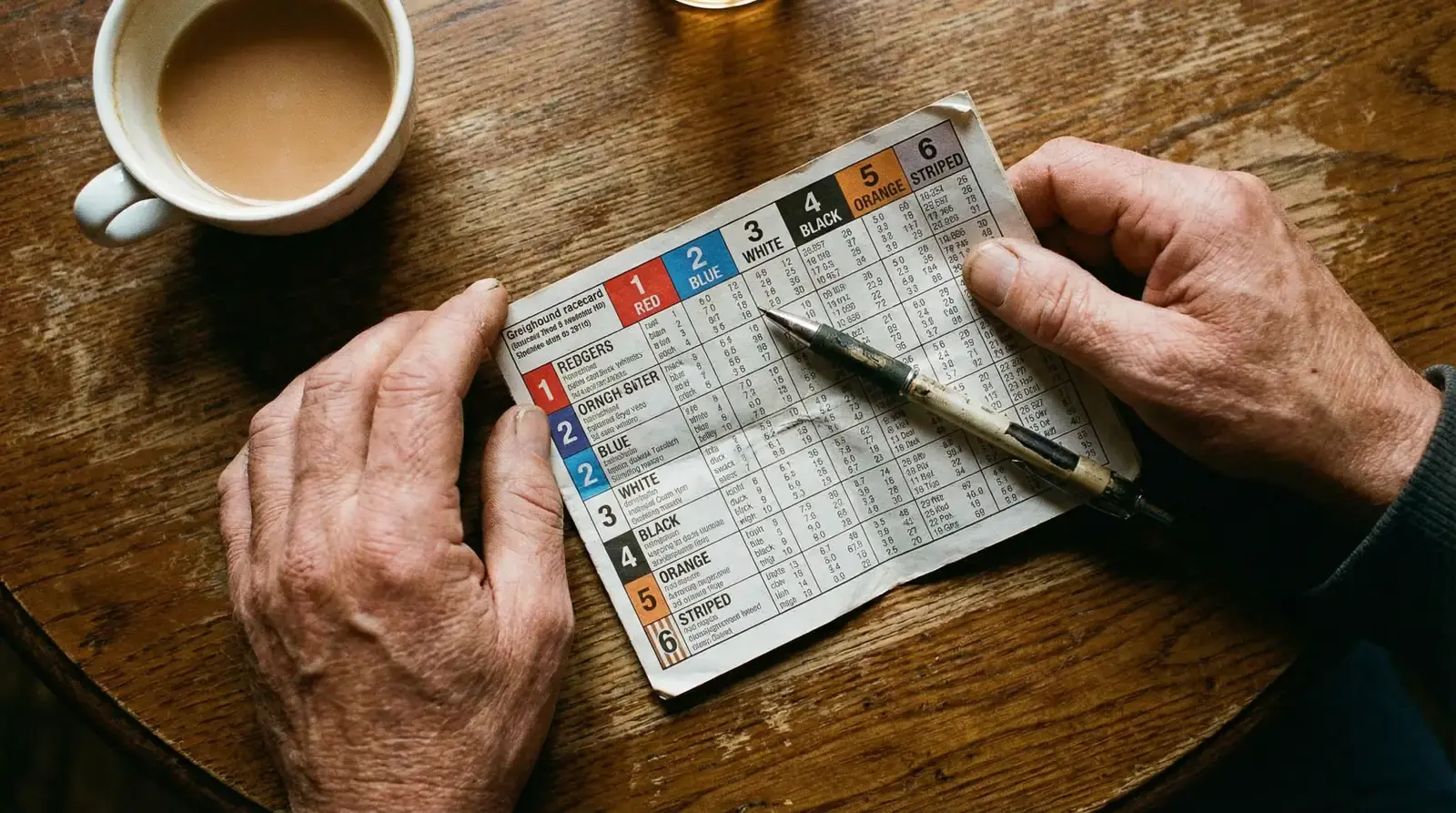
The dog’s name appears alongside its trap number and the corresponding colour — red for trap 1, blue for 2, white for 3, black for 4, orange for 5, black-and-white stripes for 6. The trap number is not cosmetic. It determines where the dog starts relative to the inside rail and the first bend, and it interacts with the dog’s running style in ways that directly affect its chances. We’ll get deeper into trap draw later, but for now, note it and move on.
The trainer’s name follows. Trainer form is an underused variable. Some kennels run hot for weeks, placing dogs well and peaking fitness at the right time. Others go through flat patches. You won’t find a trainer form table on every racecard, but knowing the name lets you look it up. Trainers at tracks like Monmore, Romford and Nottingham often specialise, and their strike rates at specific venues can be significantly above or below the overall average.
Weight is listed in kilograms, usually to one decimal place. The absolute number matters less than the trend. A dog running consistently at 32.1kg that suddenly appears at 33.0kg might be carrying condition, recovering from an issue, or simply maturing. A dog that has dropped from 30.5 to 29.8 over three runs could be getting lean and sharp — or could be struggling. Weight on its own tells you little; weight in context tells you quite a lot. Check it against the dog’s recent runs, which appear further down the card.
Season status applies to bitches and is marked with a code indicating whether she’s in season, just out of season, or unaffected. A bitch coming back from a season break can be unpredictable — some return flying, others need a run or two to find their rhythm. The racecard marks this, and ignoring it is a common mistake among casual bettors. Seasonal status is one of those details that won’t explain every result, but will explain a handful of puzzling ones over any given month.
Some racecards also show the dog’s colour (brindle, black, fawn, and so on) and sire/dam information. These are useful for breeding enthusiasts and longer-term form students but rarely influence individual race bets. The practical data — trap, trainer, weight, season — is where your attention earns its keep.
Previous Races: How to Read the Last Six Runs
Six lines of form — and every column in them feeds a different question. This is the heart of the racecard, the section that separates informed betting from wishful thinking. Each of the dog’s last six races appears as a compressed row of data: date, track, distance, trap number drawn, finishing position, time, going, weight, grade, remarks and sometimes sectional times. Read across, and you see what happened in a single race. Read down, and you see a pattern — or the absence of one.
Start with date and track. How recent is the form? A dog whose last run was three days ago is sharper — in terms of data freshness — than one returning from a four-week break. The track column tells you where each run took place. If three of the last six were at tonight’s venue, that form is directly relevant. If all six were at different tracks, you’re extrapolating more heavily and need to account for track differences.
Distance and trap come next. Has the dog been running over tonight’s distance, or is this a step up or down? Was it drawn inside last time and drawn outside tonight? These aren’t trivial details. A dog that won from trap 1 over 480m at Monmore last week is running under genuinely different conditions if drawn in trap 6 over 480m at Romford tonight.
Finishing position is the number most people check first, and on its own it’s the least useful. Finishing second in an A1 race is a stronger performance than winning an A7. Position only has meaning when you factor in grade, race quality and how the race was run. A dog that led to the third bend and faded to fourth may have shown more ability than the one that finished second by staying out of trouble at the back. This is where the remarks column earns its weight.
Time is recorded to two decimal places and represents the total race time from trap rise to the finishing line. On its own, it gives you a rough measure of pace. But raw time is misleading without context — the going (track condition) on the day might have been slow, adding tenths to every runner’s clock, or fast, flattering times across the board. This is why calculated time exists, and we’ll cover that in the results section below.
Going appears as a number — typically ranging from about -20 to +30 — representing the track’s going allowance on that day. A negative number means the track was fast (running faster than the standard time), and a positive number means it was slow. This figure is applied to the raw time to produce the calculated time, which gives you a standardised comparison across different days and conditions. Serious form readers work with calculated times, not raw ones.
Grade for each previous run tells you the class level. Look at the trajectory. Is the dog dropping in grade (being given easier races after poor results) or rising (being stepped up after wins)? A dog on its way down the grades might look like a good thing in tonight’s A6, but it might also be a dog losing form. A dog climbing grades is being tested — it might fail tonight, but if it runs well, you’re seeing genuine improvement. Grade movement is one of the clearest signals in the form lines.
Weight for each run lets you track the trend mentioned earlier. Consistent weight across six runs suggests a stable dog. Fluctuations might signal nothing — or might correlate with performance swings. Note it, compare it, but don’t overweight it as a single factor.
Split Times and Bend Positions Decoded
Split times are not finishing times — they’re pace indicators. Where available, they show how fast a dog reached specific points during the race, usually the first bend and sometimes the third bend. These are the numbers that tell you about a dog’s early pace, its ability to find a position, and whether it tends to lead, stalk or come from behind.
A fast first-bend split from trap 1 means the dog broke sharply and railed to the front. The same split from trap 6 is more impressive — the dog had to cross ground or show blistering raw speed to reach the bend in front from the widest starting position. Conversely, a slow first-bend split doesn’t necessarily mean a slow dog. It might mean the dog was bumped at the break, got squeezed for room, or simply runs a style that involves settling before finishing strongly.
Bend positions are noted as a sequence — for example, 1-1-1-1 for a dog that led at every bend, or 5-4-3-2 for one that came from behind progressively. These sequences are invaluable. They tell you whether the dog’s finishing position was earned by leading throughout (front-runners), by picking off tiring dogs in the straight (closers), or by maintaining a steady position without gaining or fading (one-pacers). Each style interacts differently with trap draw, distance and track geometry.
Not all racecards display split times — availability depends on the provider and the track’s timing equipment. Timeform and some Sporting Life racecards include them more consistently. When they’re there, use them. When they’re not, bend positions still give you a running-style profile that feeds directly into how you assess tonight’s race.
Race Remarks: The Commentary You Can’t Ignore
A three-letter code can explain why a 28-second dog ran 30. Race remarks are short annotations attached to each previous run, and they describe in-running incidents that affected the outcome. They’re the difference between seeing a bad result and understanding a bad result.
The most common remarks you’ll encounter include SAw (slow away — the dog lost ground at the start), QAw (quick away — clean, fast break), Crd (crowded — hampered by other runners during the race), Bmp (bumped — physical contact with another dog), ALd (all led — led from trap to line), Rls (rails — ran the inside line), and EvCh (every chance — had a clear run but couldn’t win). Each of these changes how you interpret the finish.
Consider a dog that finished fifth last time out. That’s an ugly number in isolation. But if the remarks show “SAw, Crd2, Bmp3” — slow away, crowded at the second bend, bumped at the third — the dog never had a fair run. Its finishing position tells you about bad luck, not bad ability. Now imagine that same dog drawn cleanly tonight with no obvious crowding risk. Suddenly fifth last time looks very different.
Conversely, a dog that won its last race but carries the remark “EvCh” for the runner-up — meaning the second dog had every chance and simply wasn’t good enough — tells you the winner had to earn it. That’s a more reliable form line than a win where the remarks show the rest of the field interfering with each other while the winner sailed through unchallenged.
Remarks reward attention. A bettor who reads them is working with a richer picture than one who only checks positions and times. Over a month of regular betting, that richer picture compounds into noticeably better decisions. But all of this — the form lines, the splits, the remarks — is pre-race information. What happens after the traps open produces a different document entirely.
From Racecard to Results: What Changes After the Race
The racecard is a prediction space — the results page is the audit. Before the traps open, the racecard gives you history and context. After the race, the results page delivers outcomes and market data. The two documents share a format, but they serve different purposes, and understanding the shift between them is essential.
A results page confirms the finishing order, records the official time, assigns remarks, and — critically — publishes the starting price. It also shows the forecast and tricast dividends if applicable, the going allowance for the meeting, and sometimes updated calculated times. Where the racecard asks “what might happen?”, the results page states “what did happen” — and then immediately becomes the newest form line on the racecard for the dog’s next race.
This cycle is the engine of greyhound form analysis. Tonight’s result feeds tomorrow’s racecard. The starting price published in the results tells you how the market assessed each dog. The race remarks tell future racecard readers how the race unfolded. The time, adjusted for going, tells them how fast the dog actually ran in standardised terms. Every data point generated by the result becomes a column in someone else’s form line within days.
For bettors, the results page is also a feedback mechanism. You backed a dog at 3/1, and it won — but was the SP 2/1 or 5/1? If you took the price early and SP drifted to 5/1, the market moved against your selection after you committed. That’s information. If SP was shorter than your price, the market agreed with you and the late money confirmed your read. Both outcomes teach you something, and both live on the results page.
How Starting Price Is Determined and Displayed
SP is the final snapshot of where the money went. The starting price in greyhound racing is the last price available on a runner at the moment the traps open. Unlike horse racing, where an official SP is returned by on-course bookmakers, greyhound SP is typically derived from the on-course Tote or from industry pricing mechanisms used by bookmakers for BAGS and SIS-broadcast races.
In practical terms, SP reflects the weight of money. A dog that opens at 5/1 in the morning market but goes off at 2/1 has attracted significant backing — the market has shortened it because punters (or the bookmakers’ own traders) believe it has a stronger chance than the early price suggested. A dog that drifts from 3/1 to 7/1 has been abandoned by the money — the market has lost confidence.
SP appears on the results page next to each runner. It’s displayed in fractional odds in the UK. For bettors who took an early price, comparing their price to SP tells them whether they got value or not. For those who bet at SP — common in greyhound betting because many bets are placed close to race time — the results page simply confirms what they were paid. If you use a bookmaker offering Best Odds Guaranteed on greyhounds, the comparison is even more useful: you’ll be paid whichever is higher, your price or SP.
Going Allowance and Calculated Time in Results
Raw time means nothing without the going correction. Every greyhound track in the UK measures its going — the condition of the sand surface — and expresses it as an allowance in hundredths of a second. This allowance is applied to every dog’s raw finishing time to produce a calculated time, which is the standardised figure that allows meaningful comparison across different days and different conditions.
Here’s how it works. Suppose a dog runs 29.45 seconds over 480m, and the going allowance for that meeting is +20 (meaning the track is running slow by 0.20 seconds compared to standard). The calculated time is 29.45 minus 0.20, giving 29.25 seconds. That 29.25 is what you compare to the dog’s previous runs and to other dogs’ calculated times at the same distance. If you compared the raw 29.45 against a 29.30 run on a normal-going day, you’d think the dog ran slower — when in fact it ran faster once conditions are accounted for.
Going is affected by weather, watering, time of day and how much racing has taken place on the surface. Sand tracks generally ride slower after heavy rain and can speed up as they dry. Some tracks water between races to maintain consistency; others allow the surface to evolve through a meeting. The going allowance is measured and published by the track officials for each meeting, and it appears in the results alongside each dog’s data.
Calculated time is the great equaliser. Two dogs running at different tracks on different days can be compared meaningfully only through their calculated times. It’s not a perfect system — track geometry and circuit size still introduce variables — but it’s vastly more reliable than comparing raw times. If you’re serious about greyhound form, you work in calculated times. Everything else is noise.
Complete Greyhound Racecard Abbreviations Reference
The shorthand can look like a foreign language — here’s the dictionary. Greyhound racecards and results use dozens of abbreviations to condense race commentary into tight spaces. You don’t need to memorise every one before placing a bet, but you do need to recognise the codes that directly affect how you read form. Below is a comprehensive reference, grouped by what they describe.
Starting and early pace codes appear frequently. QAw means quick away — the dog broke cleanly and gained an early advantage. SAw means slow away — a poor start that cost ground. These two codes alone can reframe a result. A dog that finished third with SAw might have won with a clean break. MsdBrk (missed break) is the more extreme version of SAw, indicating the dog was significantly slow out of the traps. EvPc (even pace) describes a dog that ran consistently without accelerating or fading, while EP (early pace) notes that the dog showed speed in the opening phase.
Positional and running codes describe what happened during the race. ALd means all led — the dog was in front at every recorded point. Led1, Led2, Led3 and Led4 indicate the dog led at the first, second, third or fourth bend respectively. Rls (rails) means the dog ran along the inside running line. Wd (wide) means it raced wide, often losing ground on the bends. Mid indicates a middle track position.
Contact and interference codes are among the most important for form reading. Crd (crowded) means the dog was hemmed in or impeded without direct contact. Bmp (bumped) indicates physical contact with another runner. CrdRnUp (crowded run-up) means interference on the home straight. Bmp1, Bmp2, Bmp3, Bmp4 specify the bend where the bumping occurred. Ck (checked) means the dog had to noticeably adjust its stride due to another runner. Fell means exactly what it sounds like, and these runs should be treated with caution — a fall can knock confidence and cause physical issues that don’t always appear in the weight column.
Finishing codes round out the picture. RnOn (ran on) means the dog was finishing strongly, suggesting the distance or a longer trip might suit. Fdd (faded) means the opposite — the dog weakened in the latter stages. EvCh (every chance) is a significant code meaning the dog had a clear, unimpeded run but still couldn’t win, which tells you it was beaten on merit rather than misfortune. NrLn (near line) means the dog was closing right at the finish, often implying another stride or two might have changed the result. FnsWl (finished well) is similar, describing a strong closing effort.
Track condition and official codes include the going measurement (N for normal, S for slow, F for fast, and variations between), NR for non-runner, and occasionally V for void race. The going abbreviation in a form line refers to the conditions on the day of that particular race, not today’s going — a distinction that trips up newer readers.
These abbreviations are standardised across GBGB-licensed tracks, so the same codes apply whether you’re reading form from Romford, Nottingham, Monmore Green or anywhere else in the licensed circuit. Once you’re fluent in them, reading a racecard stops feeling like translation and starts feeling like listening to a conversation the dog has already had with the track.
The Card Only Gets You Halfway There
A racecard is data — what you do with it is craft. Everything covered in this guide gives you the tools to read greyhound racecards and results with genuine comprehension. You can decode the abbreviations, interpret the split times, adjust for going, read the remarks and understand what the finishing positions actually mean in context. That’s a real skill, and it puts you ahead of the majority of casual bettors who never get past the surface numbers.
But reading the card is the beginning, not the end. The racecard tells you what has happened. It doesn’t tell you what will happen. The dog that has won its last three races might face a different trap, a new distance, or a rival it hasn’t met. The weight might have shifted, the going might have changed, the trainer might be running it back quickly after a hard race. The card gives you the raw material; you still have to assess it, weigh the variables, and make a judgment under uncertainty. That’s what betting is.
The best racecard readers in greyhound racing don’t treat the form lines as prophecy. They treat them as evidence — incomplete, sometimes contradictory, but worth studying carefully. They know that a dog’s history is a guide, not a guarantee. And they know that the process of reading the card properly, race after race, meeting after meeting, is what builds the kind of pattern recognition that no shortcut can replace. The card gets you halfway there. Experience, discipline and honest assessment of your own decisions cover the rest.