Best Greyhound Betting Sites – Bet on Greyhounds in 2026
Loading...
Not All Traps Are Equal — the Numbers Prove It
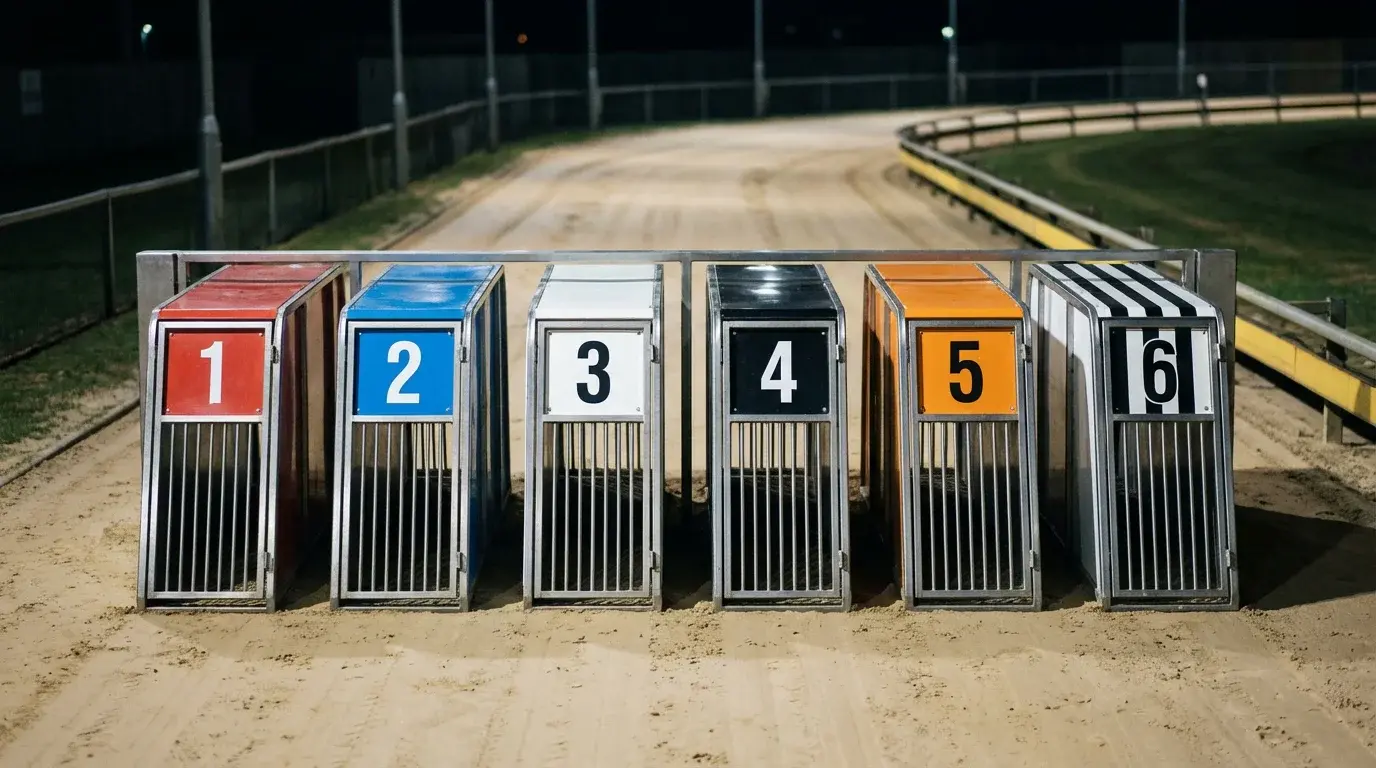
Not all traps are created equal, and pretending otherwise costs money. In UK greyhound racing, every dog in a six-runner field is assigned a starting trap numbered 1 through 6, each colour-coded: red, blue, white, black, orange, and black-and-white stripes. The trap determines the dog’s position at the start — its proximity to the inside rail, its distance from the first bend, and its spatial relationship to the other five runners.
Over thousands of races, patterns emerge. Certain traps produce more winners at certain tracks. The imbalance is not dramatic — this is not a rigged game — but it is consistent enough to matter at the margins. And margins are exactly where profitable greyhound betting lives.
Understanding trap statistics does not mean blindly backing whichever trap has the highest historical win rate. It means incorporating trap draw as one variable among several — alongside form, pace, going, and distance — when assessing a dog’s chances. Used properly, trap data adds a layer of discipline to an analysis that might otherwise rely too heavily on gut feeling or headline form figures.
Why Trap Draw Matters in Greyhound Racing
The trap a greyhound starts from affects its race in several concrete ways. First, it determines the angle to the first bend. At most UK tracks, the traps are positioned on a straight section of the track, and the dogs run toward the first bend after leaving the boxes. Dogs drawn in Trap 1 (red) are closest to the inside rail. Dogs in Trap 6 (stripes) are furthest from it. Depending on the distance from the traps to the first turn, this positional difference can be significant.
At tracks where the run to the first bend is short, inside-drawn dogs have a natural advantage. They reach the rail sooner, take a shorter path around the bend, and can establish position before wider-drawn runners have time to cut across. At tracks with a longer run-in, the advantage diminishes because all six dogs have more time to find their preferred line before the turn.
Second, trap draw interacts with individual running style. Some greyhounds are natural railers — they hug the inside throughout the race. Others prefer to run wide, finding space on the outside of the pack. A railer drawn in Trap 6 faces an immediate problem: it needs to cross five lanes of traffic to reach the rail, often losing ground and risking interference in the process. Conversely, a wide runner drawn in Trap 1 may be forced inside against its natural tendency, leading to crowding at the first bend.
Third, trap draw affects interference risk. Dogs drawn in the middle traps — 3 and 4 — are flanked on both sides. They can be squeezed by dogs converging from the inside and outside. Dogs on the rail or on the wide outside have at least one open flank, which reduces the probability of being knocked or baulked in the critical first few seconds after trap rise.
These physical dynamics create statistical patterns that accumulate over large sample sizes. A trap that sits closer to the rail at a tight-turning track might produce 20 per cent of all winners, while a trap on the outside at the same venue might produce only 12 per cent. That eight-percentage-point gap represents real value if the market fails to account for it.
Individual dog form is always more important than raw trap stats. A dog with superior form and pace will overcome a poor draw more often than not. But when two dogs look closely matched on form, trap draw can be the deciding factor — and the historical data provides evidence for that judgment rather than leaving it to speculation.
Track-by-Track Trap Win Rates Across UK Venues
Trap statistics vary meaningfully across UK greyhound venues, and the variation is not random. It reflects the physical geometry of each track — circumference, distance to the first bend, bend radius, and the position of the starting boxes relative to the rail. These structural features remain constant (barring renovations), so trap bias at a given track tends to persist over time.
At tracks with tight first bends and short run-ins — Romford being a prime example — Trap 1 historically outperforms. The inside draw saves ground on the bend, and in sprint races where every fraction of a second counts, that saved ground translates directly into finishing position. At Romford, Trap 1 win rates have consistently sat above the statistical average of 16.7 per cent (which is what each trap would produce if results were perfectly evenly distributed across six traps).
At larger, more galloping tracks like Towcester, the advantage is less concentrated. The longer run to the first bend gives wider-drawn dogs more time to settle into their stride and find position. Middle traps — 3 and 4 — sometimes show stronger records at these venues, as they offer a balanced starting position without the extremes of the rail or the wide outside.
Monmore Green tends to favour traps on the inside half of the draw (1 and 2) in sprint races, though the bias narrows in middle-distance events where the longer running distance allows wider-drawn dogs to recover lost ground. Sheffield and Nottingham, with their respective track geometries, each show their own patterns that can be traced through publicly available results archives.
The Greyhound Board of Great Britain (GBGB) does not publish a centralised trap statistics dashboard, but third-party sites — most notably Greyhound Stats UK — compile trap win data by venue, distance, and grade. Timeform’s racecard pages also display individual trap records for the relevant track in their “Pointers” section. These resources allow you to compare current-season trap performance against longer-term trends.
It is worth checking these statistics at distance level, not just overall. A track might show an even split across traps at 480 metres but a strong Trap 1 bias at 260 metres, because the sprint distance puts a premium on the inside rail. Aggregating all distances into a single trap stat for a venue masks these important distinctions.
The key venues to watch for pronounced trap bias include Romford (inside favoured in sprints), Hove (historically balanced, but weather-dependent shifts), and Perry Barr (where the longer distances tend to normalise trap advantage). Crayford, which closed permanently in January 2025, historically showed an inside advantage on its tighter bend configuration — a useful illustration of how track geometry drives trap bias, even though the venue is no longer operational. At every track, the data tells a story — but only if you read it at the right level of granularity.
How to Use Trap Statistics in Your Betting
The first step is knowing that trap stats exist. The second step is knowing how not to misuse them. The most common mistake is treating trap data as a standalone system — backing Trap 1 at Romford in every sprint regardless of the dogs involved. That approach ignores form entirely and will lose money over any meaningful sample size, even at a track where Trap 1 wins more often than the other traps.
The correct way to use trap statistics is as a tiebreaker and an adjustment factor. When two dogs look closely matched on form, time, and class, the one drawn in a historically stronger trap has a marginal edge. That marginal edge might not show up in any individual race, but across fifty or a hundred similar situations, it compounds into a measurable advantage.
Similarly, trap data can help you identify when a dog’s recent form might be misleading. A dog that has won two of its last three races from Trap 1 at a track where Trap 1 is strongly favoured may have been benefiting from draw advantage rather than demonstrating superior ability. If that same dog switches to Trap 5 at the same track, the historical data suggests it may not replicate that form. This is not a certainty — the dog might be genuinely fast enough to win from any box — but the data provides a reason for caution that pure form reading would miss.
Another application is in forecast and tricast betting. Trap stats help you think about which dogs are most likely to fill the places (second and third) as well as win. A dog from a weaker trap that has strong late pace might not win but could consistently finish in the top three — making it a useful inclusion in combination forecast or tricast selections.
Finally, check trap stats for the specific meeting conditions. Some trap biases are amplified in wet weather, when the track surface behaves differently. Rain can make the inside rail slower if water pools there, or it can make the outside lane heavier. Monitoring trap results across the first few races of a rain-affected meeting can reveal whether the usual patterns are holding or whether conditions have temporarily shifted the balance.
Trap Bias Over Time: Why the Numbers Shift
Trap bias is not fixed permanently. It evolves. Tracks undergo maintenance — the surface is resanded, bends are re-profiled, the hare rail is adjusted. Each of these changes can subtly alter the physical dynamics that produce trap advantage. A track that favoured inside traps for three consecutive seasons might show a more even distribution after a resurfacing, or might shift to favour middle boxes if the new surface drains differently.
Seasonal weather patterns also create short-term shifts. A sustained dry spell hardens the sand and tends to benefit faster dogs from any trap, while prolonged rain can create inconsistencies in surface grip that favour the inside (where the track is often more compacted and drains faster) or the outside (where fresher, less-worn sand might provide better traction). These effects are track-specific and time-limited, which is why relying solely on long-term aggregate trap data without checking recent trends can lead to stale conclusions.
The practical response is straightforward: update your trap data regularly. Check the last 30 to 60 days of results at any venue you bet on frequently, and compare current trap performance against the longer-term baseline. If a significant divergence appears — Trap 1 winning at double its usual rate, or Trap 6 suddenly outperforming — investigate whether anything structural has changed at the track. If it has, adjust your model. If it has not, treat the divergence as short-term variance and expect it to revert.
The Trap Is a Variable, Not a Verdict
No trap number, on its own, will ever tell you who wins a race. What the numbers do is quantify the conditions each dog faces in the opening seconds — the angle to the first bend, the risk of interference, the likelihood of finding clear running space. Those conditions shape outcomes, not deterministically, but probabilistically.
The bettors who profit from trap data are not the ones who build a system around it. They are the ones who add it to a process that already includes form reading, time analysis, class assessment, and going conditions. The trap is one input among many. But it is an input with hard data behind it, and in a market where most bettors never look at it, even a small informational edge goes a long way.