Best Greyhound Betting Sites – Bet on Greyhounds in 2026
Loading...
Same Principle, Different Game
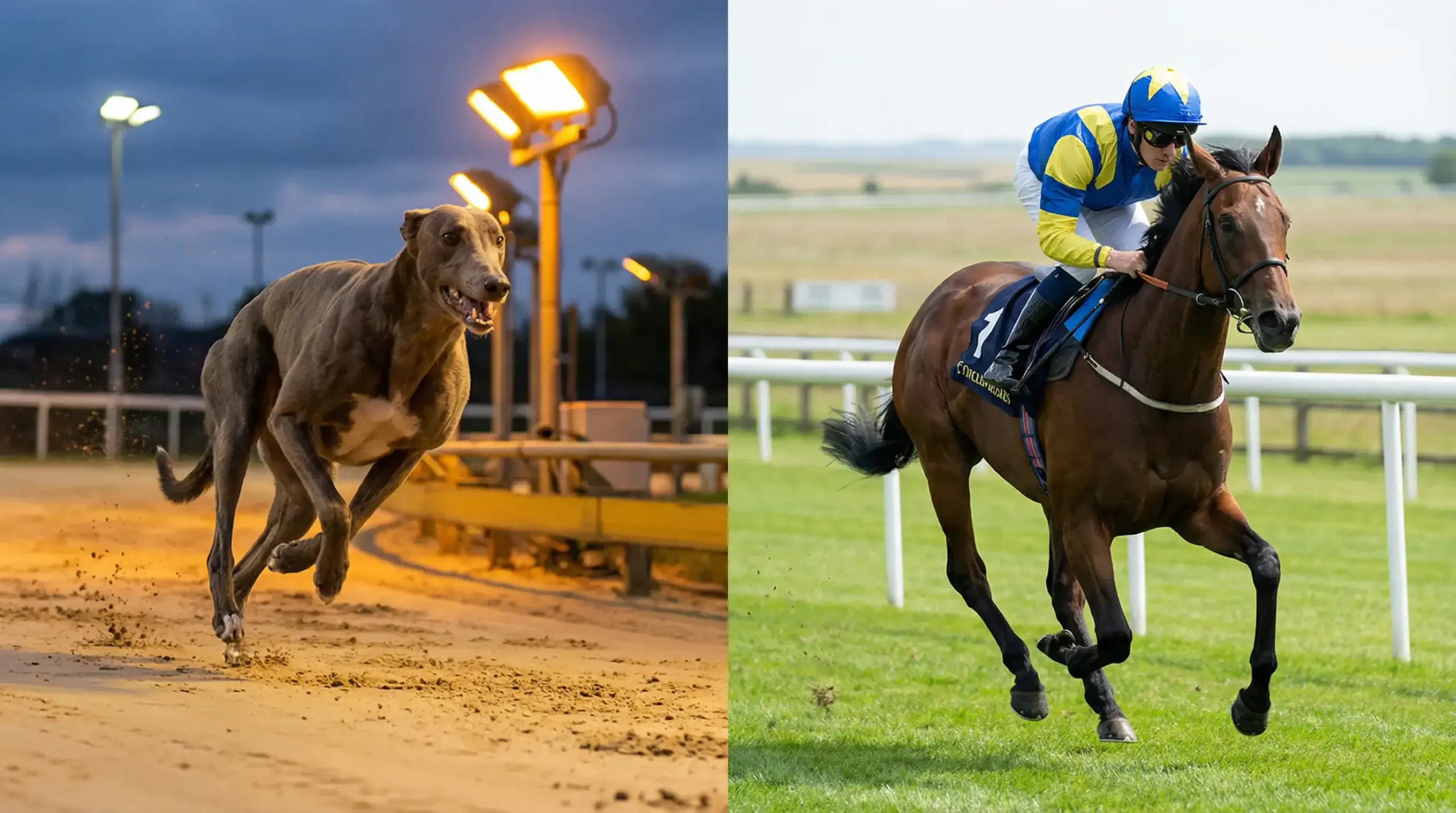
Many greyhound bettors came to dog racing from horse racing. The crossover is natural — both involve racing animals on a track, both have form books, both offer a range of bet types from singles to forecasts, and both are deeply embedded in UK betting culture. The temptation is to assume that the skills transfer directly. Some do. Others require significant recalibration.
Greyhound racing and horse racing share a framework but differ in almost every detail. The field sizes, the frequency of racing, the pace of the action, the role of the jockey (or its absence), the going, the form cycles, and the betting market structures are all distinct. A bettor who applies horse racing habits to greyhound betting without adjusting for these differences will find that their analytical edge does not translate as cleanly as expected.
This guide outlines the key differences between the two sports from a betting perspective, explains where horse racing instincts help and where they mislead, and suggests which type of racing might suit different betting styles and temperaments.
The Key Differences Between Greyhound and Horse Racing
The most immediately obvious difference is the absence of a jockey. In horse racing, the rider is a variable — their skill, their tactical decisions, their ability to execute a race plan. In greyhound racing, there is no rider. The dog makes its own decisions after the traps open, and those decisions are governed by instinct, training, and the physical dynamics of the pack around it. This removes an entire layer of analysis from the form equation. You are assessing the animal alone, not an animal-rider partnership.
The second major difference is race frequency. A horse might race once every two to four weeks. A greyhound can race two or three times per week, sometimes more. This frequency means the greyhound form book updates rapidly — a dog’s last six runs might span only a fortnight — and the relevance of historical form decays faster. Recent results carry more weight in greyhound racing because the sample is more current and the dog’s condition is more tightly linked to its most recent performances.
Race duration is dramatically different. A greyhound sprint lasts under 16 seconds. A standard middle-distance race takes 28 to 32 seconds. Even a marathon event is over in under a minute. By comparison, a flat horse race lasts one to four minutes, and a jumps race can exceed five minutes. The compressed timeframe in greyhound racing means there is less room for tactical manoeuvring and less time for mistakes to be corrected. The first few seconds — the break from the traps and the approach to the first bend — are disproportionately influential in determining the final result.
The surfaces are different. Greyhounds race on sand. Horses race on turf, all-weather polytrack, or dirt. The going terminology differs accordingly, and the impact of conditions on performance follows different patterns. Sand-based going in greyhound racing is less variable than turf going in horse racing, where the difference between good ground and heavy ground can fundamentally change the race.
Finally, the betting ecosystem differs in scale. Horse racing attracts deeper liquidity, more sophisticated punters, and sharper markets. Greyhound markets are thinner, with wider margins and less informed price movements. This cuts both ways — the thinner market means more opportunities for value-seeking bettors but also more noise and less reliable price signals.
Field Sizes and What They Mean for Odds
UK greyhound races have six runners. Always six, barring the occasional non-runner that reduces the field to five. Horse races can have anywhere from four to forty runners, depending on the race type and conditions. This single structural difference changes the entire betting dynamic.
With six runners, the favourite in a greyhound race is more likely to win than the favourite in a large-field horse race. Statistical analysis of UK greyhound racing shows that favourites win approximately 30 to 35 per cent of all races — a strike rate that would be exceptional in horse racing fields of twelve or more. The smaller field concentrates probability among fewer runners and reduces the scope for upsets caused by traffic, interference, or positioning luck.
The odds structure reflects this. Greyhound prices are generally shorter than horse racing prices for equivalent positions in the market. A 2/1 favourite in a six-dog greyhound race represents a different implied probability from a 2/1 favourite in a sixteen-runner horse race handicap. The greyhound favourite’s 33 per cent implied probability is a reasonable assessment of its chances. The horse racing favourite at the same price in a sixteen-runner field is likely overbet relative to the number of possible outcomes.
For forecast and tricast betting, smaller fields mean fewer permutations and lower dividends on average. A greyhound forecast has 30 possible first-and-second combinations. A horse racing forecast in a twelve-runner race has 132. The greyhound dividend is correspondingly smaller because the probability of any given combination is higher. This does not make greyhound forecasts bad value — it means the scale of returns is different, and expectations should be calibrated accordingly.
The six-runner structure also makes each-way betting less generous in greyhound racing, as only two places are paid at 1/4 the odds, compared to the more generous place terms available in larger horse racing fields.
Form Reading: Dogs vs Horses
Form reading in both sports follows the same basic principle: assessing past performance to predict future results. The mechanics of how you read the form, however, differ in important ways.
In horse racing, form analysis incorporates the jockey, the trainer, the draw, the distance, the going, the class, the weight carried, and the pace of the race. The number of variables is large, and the interaction between them creates complexity that rewards deep analysis. In greyhound racing, the variables are fewer — trap draw, going, distance, class, and the dog’s running style — but each variable has a more direct and measurable impact because there are fewer confounding factors. The absence of a jockey removes the biggest source of unpredictable human intervention.
Greyhound form cycles are shorter and more volatile. A dog in peak form can lose it within a week or two — age, minor injury, fitness decline, or simple loss of enthusiasm can cause a sudden drop-off. In horse racing, form cycles tend to be longer and more gradual, with horses maintaining their level across a season or more. This means greyhound form requires constant updating and a heavier weighting on the most recent runs.
Sectional data is more accessible and more directly applicable in greyhound racing than in many horse racing contexts. The standardised track layouts (ovals with consistent distances) and electronic timing systems at UK greyhound tracks produce consistent split times that can be compared across meetings at the same venue. Horse racing sectionals, while increasingly available, are complicated by course undulations, variable going across different parts of the track, and inconsistent measurement points between courses.
One area where horse racing form skills transfer directly is the assessment of class and grade changes. The principle of evaluating a runner’s form relative to the quality of competition it has faced is identical in both sports. A dog stepping up in grade and a horse stepping up in class present the same analytical question: has this animal proven it can compete at the higher level?
Which Type of Racing Suits Your Betting Style
Greyhound racing suits bettors who value frequency, speed, and simplicity. If you want multiple betting opportunities every day, rapid results, and a smaller set of variables to analyse, the dogs are a natural fit. The short races and quick turnaround between events suit punters who prefer action and volume over patience and depth.
Horse racing suits bettors who enjoy deep analysis, longer-term planning, and the richness of a form book that evolves over months and seasons. If you prefer studying a horse’s campaign across an entire season, factoring in jockey bookings and trainer intentions, and waiting for the right race on the right day, horse racing rewards that patience with a deeper and more nuanced analytical experience.
Many successful bettors operate across both sports, using greyhound racing for daily engagement and short-term betting, while reserving their most serious analytical work for selected horse racing fixtures. The skills developed in one sport sharpen the instincts used in the other — discipline, value assessment, staking control, and the ability to read a form book are universal. The details are different, but the discipline is the same.
Two Tracks, One Discipline
Greyhound racing is not horse racing in miniature. It is a distinct sport with its own rhythms, its own market dynamics, and its own analytical demands. The bettor who respects those distinctions — adjusting their approach rather than importing habits wholesale — will find dog racing a rewarding and profitable complement to whatever other betting they do.
The two sports run on different tracks, at different speeds, to different rules. The discipline of finding value and managing risk, however, runs through both. Master that discipline in either, and the other becomes significantly easier to navigate.