Best Greyhound Betting Sites – Bet on Greyhounds in 2026
Loading...
Two Dogs Cross the Line Together — Now What?
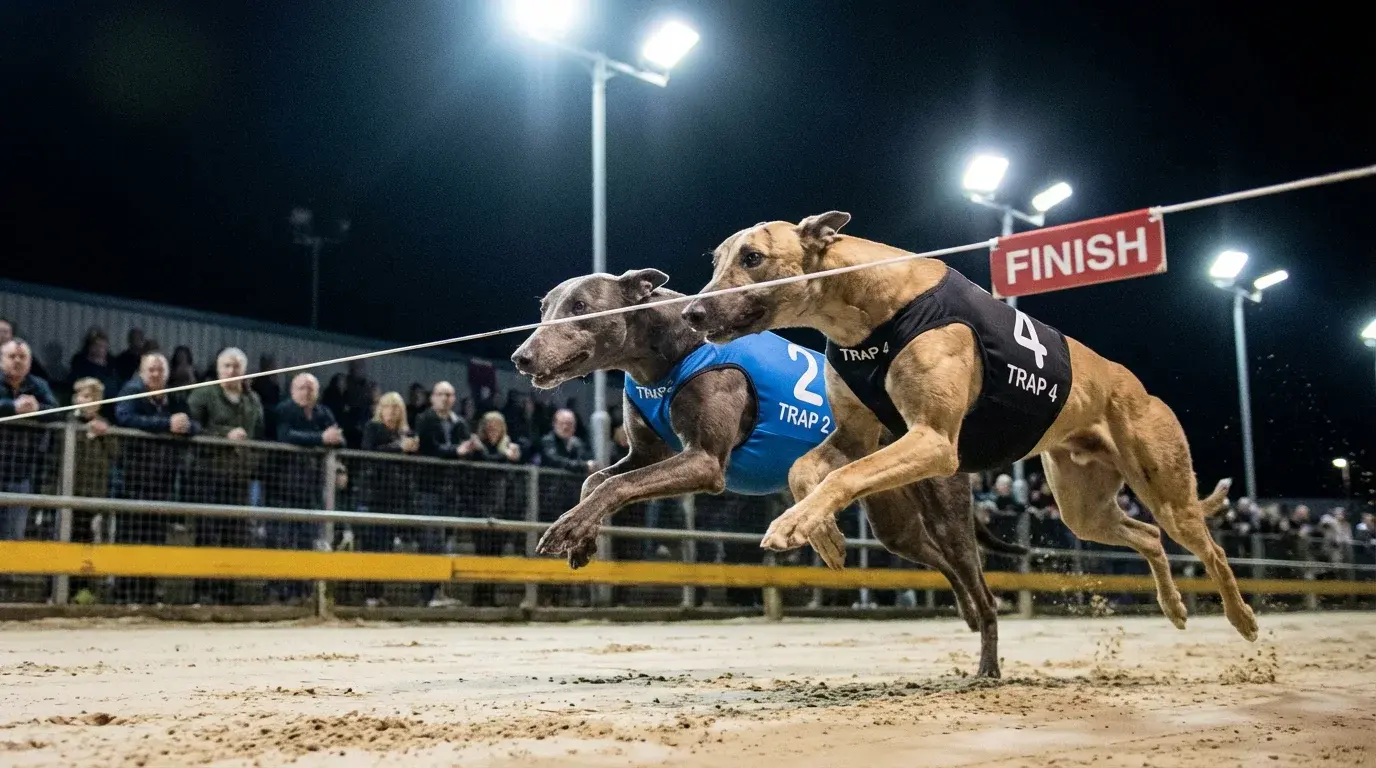
Greyhound racing is decided by fractions — fractions of a second, fractions of a length. Most of the time, the photo-finish camera can separate the runners and assign a clear finishing order. Occasionally, it cannot. When two or more dogs cross the line simultaneously and cannot be separated, the result is declared a dead heat.
Dead heats are uncommon in greyhound racing, but they are not rare enough to ignore. When one occurs, it changes how every bet on the affected positions is settled. The rules are standardised across the industry, but the mechanics catch many bettors off guard — particularly the impact on forecasts and tricasts, where the ripple effects extend beyond the tied position itself.
Understanding dead heat settlement before it happens is better than discovering it on your bet slip after it happens. This guide explains what triggers a dead heat, how the payout calculation works, how it affects exotic bets, and where bookmaker rules can differ.
What Triggers a Dead Heat in Greyhound Racing
A dead heat is declared when the photo-finish system cannot separate two or more dogs at the winning line. Every UK greyhound track uses a photo-finish camera positioned at the finish line to produce a strip image of the dogs as they cross. The camera captures the precise moment each dog’s nose reaches the line, and the judge examines the image to determine finishing positions.
If the judge determines that two dogs reached the line at the same instant — their noses aligned to within the resolution of the camera — a dead heat is declared for that position. A dead heat for first place means both dogs are joint winners. A dead heat for second means both are joint runners-up. The same principle applies to any finishing position, though dead heats for first are the most consequential for betting purposes.
Dead heats are more likely in certain types of race. Sprint races, where dogs run at maximum speed with minimal tactical variation, tend to produce tighter finishes than middle-distance or staying events. Races with two front-runners of similar ability, drawn in adjacent traps, are classic dead-heat candidates — both dogs break fast, run side by side through the bends, and arrive at the line together. Wider, more tactical races with multiple position changes are less likely to produce a dead heat because the finishing order tends to spread out as dogs make their moves at different points.
The dead heat declaration is final once the judge confirms the result. Unlike some other sports, there is no appeal process or video review that overrides the photo-finish determination. If the image shows the dogs inseparable, the dead heat stands, and all bets are settled accordingly.
It is worth noting that a dead heat is different from a close finish that is separated by the photo. A dog beaten by a short head — the smallest official winning margin in greyhound racing — is still beaten. The photo must show the dogs genuinely inseparable for a dead heat to be declared. Close does not count; identical does.
How Dead Heat Payouts Are Calculated
The dead heat rule in betting is straightforward in principle: your stake is divided by the number of dead-heating participants, and the payout is calculated on the reduced stake at full odds. In practice, this means you receive half the normal return if two dogs dead-heat, a third if three dead-heat, and so on.
Take a concrete example. You back a dog at 4/1 with a ten-pound stake. The dog dead-heats for first with one other runner. Under dead heat rules, your stake is halved to five pounds. That five pounds is paid out at the full odds of 4/1, giving you twenty pounds profit plus your five-pound reduced stake, for a total return of twenty-five pounds. Without the dead heat, the same bet would have returned fifty pounds (forty pounds profit plus ten pounds stake). The dead heat has halved your return.
The formula generalises: total return equals (stake divided by number of dead-heaters) multiplied by (odds plus one). For fractional odds, this is (stake / N) x ((numerator / denominator) + 1). For decimal odds, it is (stake / N) x decimal odds.
A common source of confusion is the difference between halving the stake and halving the payout. They produce the same result mathematically, but the dead heat rule specifically halves the stake and pays full odds on the reduced amount. This distinction matters when the dead heat involves place bets or each-way bets, where the odds on the win and place components differ.
For each-way bets affected by a dead heat, the rule is applied separately to each component. If your dog dead-heats for first in an each-way bet, the win part is settled at half stake at full odds, and the place part is also settled at half stake at the place fraction. If the dead heat is for second place (affecting only the place part), the win part is lost entirely and the place part is settled at half stake at the place odds.
Dead heats involving three dogs are extremely rare in six-runner greyhound races, but the principle extends: your stake is divided by three, and the payout is calculated on the reduced amount. The more dogs involved, the smaller your effective stake, and the smaller your return.
One detail that surprises some bettors: a dead heat for first means both dogs are officially winners. If you backed one of the dead-heaters and someone else backed the other, you both win — but you both receive reduced payouts. The bookmaker does not pay out at full odds to both and absorb the cost. The dead heat rule protects the bookmaker’s position by ensuring total liability on the race does not exceed what it would have been with a single winner.
Dead Heats in Forecast and Tricast Bets
Dead heats create more complex settlement in forecast and tricast markets because these bets depend on the exact finishing order, and a dead heat means no exact order exists for the tied position.
In a straight forecast, if the two dogs you selected for first and second dead-heat for first, the outcome is ambiguous — both possible orderings of your two selections are equally valid. The standard settlement is to pay the forecast as a dead heat, which typically means averaging the two possible CSF dividends (your first selection winning and the other second, versus the reverse) and paying half of that average. The effect is a reduced dividend compared to a clean first-and-second finish.
If a dead heat occurs for a position that affects one of your forecast selections but not the other — say your first selection wins clearly but your second selection dead-heats with another dog for second — the forecast is settled with the dead heat rule applied to the second position. Your dividend is halved because your second selection is sharing the runner-up spot. The CSF is calculated as if your dog finished second, and the return is divided by the number of dogs sharing that position.
Tricast settlement under dead heat conditions is even more intricate. If any of the first three positions involves a dead heat, the number of valid finishing-order permutations increases, and the tricast dividend is adjusted accordingly. In practice, dead heats in the first three positions of a greyhound race are rare enough that most bettors will encounter this situation only occasionally. When it does arise, the bookmaker calculates the settlement based on the specific dead heat scenario and the CT formula, and the resulting dividend is typically lower than a clean tricast would have returned.
The key principle across all exotic bets is consistent: a dead heat shares the position between the tied runners, and the bet is settled on a proportionally reduced basis. The more complex the bet type, the more complicated the settlement arithmetic becomes, but the underlying logic remains the same.
Bookmaker Variations and Edge Cases
The core dead heat rule — divide the stake by the number of tied runners, pay at full odds — is standard across UK licensed bookmakers. However, there are minor variations in how specific edge cases are handled, and these are worth being aware of.
Some bookmakers apply dead heat rules to “match bets” or “trap match” markets slightly differently. In a match bet (where you pick one of two named dogs to beat the other), a dead heat typically results in the bet being voided and stakes returned, rather than settled at half odds. This is because the match bet is a head-to-head market with no provision for a tie under its standard terms. Check the specific rules for the market type you are betting on.
The treatment of dead heats in accumulator legs also varies. Most bookmakers apply the dead heat rule to the affected leg and roll the reduced return forward into the next leg. If the second leg of a four-fold acca involves a dead heat, your running stake for the third leg is halved at that point, and the rest of the acca continues on the reduced amount. This can substantially reduce the overall acca payout even if every other leg wins cleanly.
Tote (pool) bets handle dead heats by dividing the pool differently rather than applying the bookmaker dead heat rule. In Tote forecasts and tricasts, the pool payout is recalculated to account for the additional winning combinations created by the dead heat. The effect is similar — reduced returns per unit staked — but the mechanics differ from fixed-odds settlement.
The Half That Matters
Dead heats halve the celebration, not just the payout. There is something deflating about backing a winner and discovering you only won half as much as you expected. But that deflation is the cost of an inseparable finish, and the rule exists to handle a genuine ambiguity in the result — neither dog proved superior, so neither bettor gets the full reward.
The practical response is simple: know the rule exists, understand how it applies to the bet types you use, and accept the occasional reduced return as part of the variance inherent in any form of betting. Dead heats are rare enough that they should not alter your strategy. They are just common enough that being surprised by one is avoidable.