 Available in US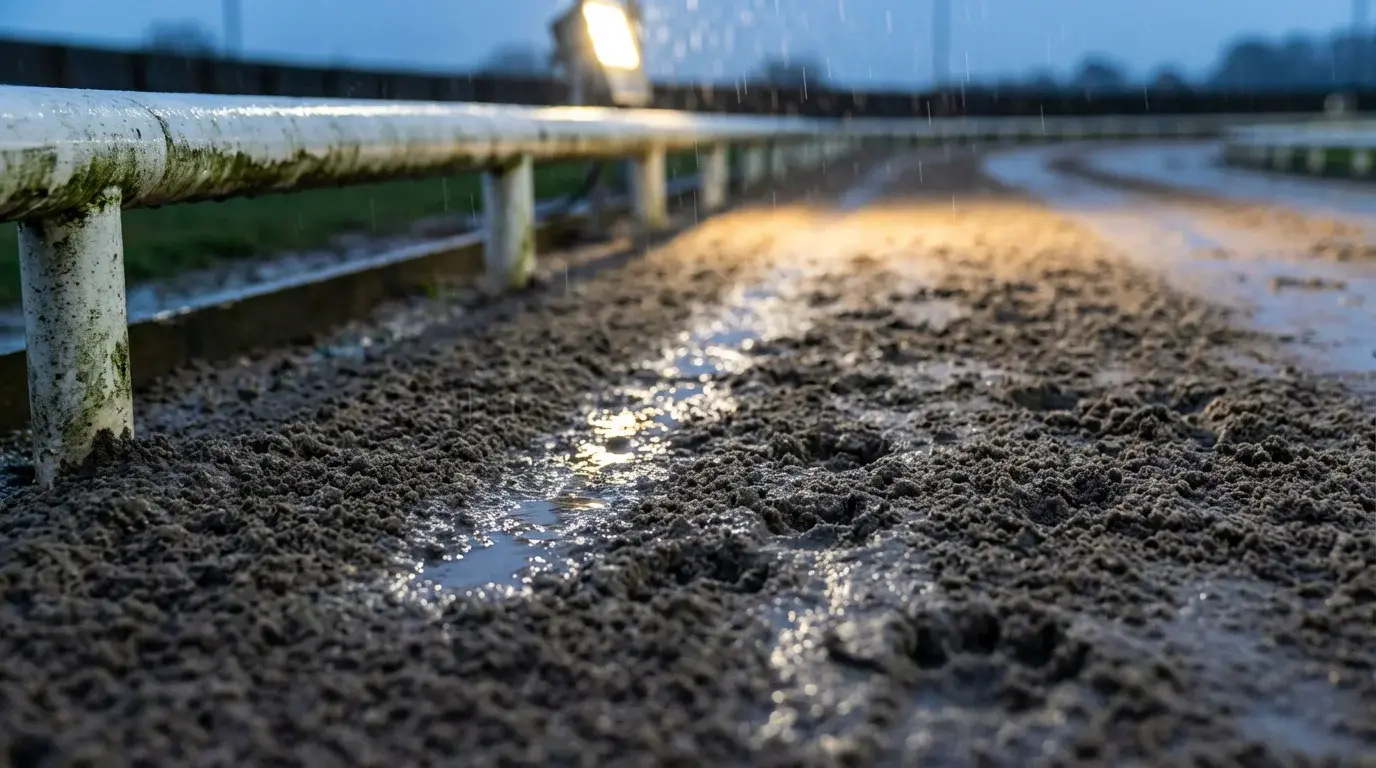
Going Is the Variable Hiding in Every Result
Every greyhound result you read was produced on a specific surface in specific conditions. The dog’s time, its finishing position, the way it handled the bends — all of it happened on sand that was either firm, damp, wet, or somewhere in between. Change the surface, and the same dog running the same race can produce a noticeably different result.
In greyhound racing, “going” refers to the state of the track surface. It is the equivalent of the going descriptions used in horse racing — good, soft, heavy — but applied to the sand tracks that UK greyhounds run on. The going affects how quickly dogs can accelerate out of the traps, how much grip they have on the bends, and how much energy it costs them to maintain top speed over the full distance. Two dogs with identical form on a dry track might separate by three lengths on a rain-soaked one, simply because one handles the changed surface better than the other.
Despite this, going is one of the most overlooked factors in casual greyhound betting. Results pages display it. Racecards acknowledge it. And most punters scroll straight past it. This guide explains what going means in practical terms, how to read it on results and racecards, how weather alters the track, and how to incorporate surface conditions into your selections.
What Going Means in Greyhound Racing
UK greyhound tracks use sand-based surfaces. Unlike horse racing, where turf and all-weather tracks offer dramatically different running conditions, the greyhound surface is always sand — but that sand behaves differently depending on how much moisture it contains, how recently it has been maintained, and what the ambient temperature is doing.
Going descriptions on greyhound racecards and results typically use a simple scale. The most common terms you will see are “normal,” which indicates a standard dry surface in its expected condition, and variations that reflect moisture: “slow,” which means the sand has absorbed rain and is heavier underfoot, and occasionally “fast” when the surface has dried and compacted to produce quicker times than usual. Some tracks and result services use slightly different terminology — you might see “good” or “standard” instead of “normal” — but the underlying concept is the same: a description of how the surface is likely to affect running times relative to the track’s baseline.
The difference between normal going and slow going is not trivial. On a slow track, running times increase because the sand offers more resistance. Dogs that rely on raw speed are penalised more heavily than dogs with stamina and determination, because the energy cost of every stride rises. A dog that clocks 29.20 on normal going at a given track might run 29.70 or slower on the same distance when the going turns heavy. That half-second gap represents several lengths at finishing speed — enough to change a comfortable winner into a beaten favourite.
Going also affects different parts of the race unevenly. The bends are where the going has its greatest impact. On a wet, heavy surface, dogs lose more traction as they corner, particularly on tighter bends. This benefits dogs with natural balance and bend technique over those that rely on straight-line speed alone. A dog that takes bends cleanly on heavy going gains ground on rivals who scrub speed through the turns.
The going is not uniform across the entire track, either. The inside rail typically receives more traffic over the course of a meeting, which can compact the sand differently from the outside lanes. On a wet evening, the inside might drain faster (compacted sand sheds water) or it might hold puddles (worn surface with depressions). These micro-variations are invisible on a racecard but visible in the results if you know what to look for.
Reading Going on Results and Racecards
Going information appears in two places: on the racecard before the race, and in the results after it. On racecards, the going is usually stated at meeting level — one description for the entire card, such as “Going: Normal” or “Going: Slow.” This tells you what the track management assessed the surface condition to be at the start of the meeting. It does not always reflect what happens later in the evening if conditions change mid-card.
In results, the going is typically recorded alongside each race. This is more useful than the racecard going because it captures the actual conditions at the time of the race rather than a pre-meeting estimate. If rain arrives during the second half of a meeting, early races might show “normal” going while later races show “slow.” Comparing a dog’s time against the going recorded for that specific race gives you a more accurate picture than comparing it against a blanket description for the meeting.
The more valuable application is comparing a dog’s form across different going conditions. Most form guides and racecard services — including Timeform — display the going for each of a dog’s previous runs. By scanning the last six or eight runs, you can identify whether a dog performs consistently regardless of conditions, or whether it shows a clear preference. A dog that finishes first and second on normal going but fourth and fifth on slow going has a surface preference — and if tonight’s racecard shows slow going, that preference should factor into your assessment.
Some dogs are genuinely versatile — they handle any surface without measurable performance loss. Others are specialists. Early-pace dogs that rely on explosive trap speed often suffer more on heavy going because the surface saps their initial burst. Strong finishers with stamina reserves sometimes improve on slower surfaces because rivals tire earlier, giving the closer more ground to make up in the final straight. Recognising which type of dog you are backing, and matching that type to the going, is one of the quieter skills in greyhound form analysis.
Calculated times — the adjusted race times published in some results services — attempt to account for going variations by applying a correction factor. A dog’s calculated time on slow going is adjusted upward to estimate what it would have run on a standard surface. These adjusted figures are helpful for cross-condition comparison, but they are not perfect. The correction factors are derived from statistical averages and may not capture the specific dynamics of a particular dog on a particular surface. Use them as a guide, not a gospel.
How Weather Reshapes the Track
Rain is the primary driver of going changes at UK greyhound tracks. A dry summer evening produces firm, fast sand. A November downpour turns it into a heavy, energy-sapping surface. The transition between these states can happen within hours, and a meeting that begins on normal going can deteriorate to slow by the final race if sustained rain falls during the card.
The timing of the rain matters as much as the volume. Light rain falling steadily throughout the afternoon tends to produce uniformly damp conditions by the time evening racing begins. A sudden heavy shower thirty minutes before the first race creates a different dynamic — the surface layer is soaked but the underlying sand may still be firm, producing a slippery top layer that drains gradually as the meeting progresses. Early races on a freshly rained track often produce slower times than later races, as the surface compacts and sheds water under the passage of the mechanical hare and the dogs themselves.
Temperature also plays a role, though it is less dramatic than rainfall. Cold conditions can harden the surface slightly if the sand has low moisture content, while warm conditions can dry out residual moisture from earlier rain. In winter, frost can create a crust on the sand that breaks up during the first few races, producing inconsistent going that stabilises mid-meeting. Track management teams water the surface in dry weather to prevent it becoming too firm and dusty, but the amount and timing of watering varies between venues.
Wind is an underappreciated factor. Strong headwinds on the straight sections of the track slow dogs down, while tailwinds can produce artificially fast times. Wind does not change the going description — the sand is the same regardless of wind — but it changes the times that the going produces. If you are comparing a dog’s time from a windy meeting against a sheltered one, the going description alone does not tell the full story.
The practical lesson is to treat the stated going as a starting point, not a final verdict. Check the local weather forecast for the track’s area. Look at results from earlier races on the same card if they are available. And pay attention to any mid-meeting going updates that bookmaker or results services publish. A going change between Race 4 and Race 5 can meaningfully alter the dynamics of later races on the card.
Adjusting Your Betting for Going Conditions
The simplest adjustment is to check whether the dogs in a race have proven form on the going that is expected tonight. If the track reports slow going and three of the six runners have never raced on slow going at this track, you are dealing with unknowns. The dogs with established form on the surface have a quantifiable advantage — you know they can handle it. The others might cope fine, or they might lose two lengths through the bends. That uncertainty should be reflected in how you assess the field.
Beyond individual dog assessment, going conditions affect trap draw dynamics. On heavy going, inside traps may lose their usual advantage if the rail area has absorbed more water. Conversely, the wider lanes — which receive less traffic and may drain differently — can provide better traction. If you normally weight Trap 1 heavily at a particular track, check whether that bias holds on slow going by reviewing recent results in similar conditions.
Staking adjustments are also worth considering. If you are betting on a meeting where the going is uncertain — rain is forecast but has not arrived, or the track has been watered but the extent is unclear — reducing your stakes slightly accounts for the added unpredictability. Going uncertainty increases variance, and higher variance favours smaller stakes. This is not caution for its own sake; it is bankroll management applied to the specific risk factor that the surface introduces.
Finally, going conditions create value opportunities. When the going changes mid-meeting, the market does not always react quickly. A dog priced at 3/1 in the morning on the assumption of normal going might still be 3/1 by the time the seventh race is run on slow going, even though its form on that surface is markedly worse than a rival priced at 5/1 who thrives in the conditions. Spotting these mismatches requires paying attention to the going throughout the meeting, not just at the start.
The Ground Beneath the Race
Going is not the most glamorous variable in greyhound racing. It does not have the visual clarity of trap draw or the narrative appeal of a dog stepping up in grade. But it sits beneath every result, quietly shaping times, positions, and margins. The dogs do not run on a spreadsheet — they run on sand, and the state of that sand changes what is possible on any given night.
Bettors who account for going conditions are working with a more complete picture than those who ignore them. It does not require complex modelling or specialist equipment. It requires checking one line on the racecard, comparing it against the dog’s form record, and thinking about what it means for the race ahead. That small act of attention, repeated consistently, separates informed selections from educated guesses.
