 Available in US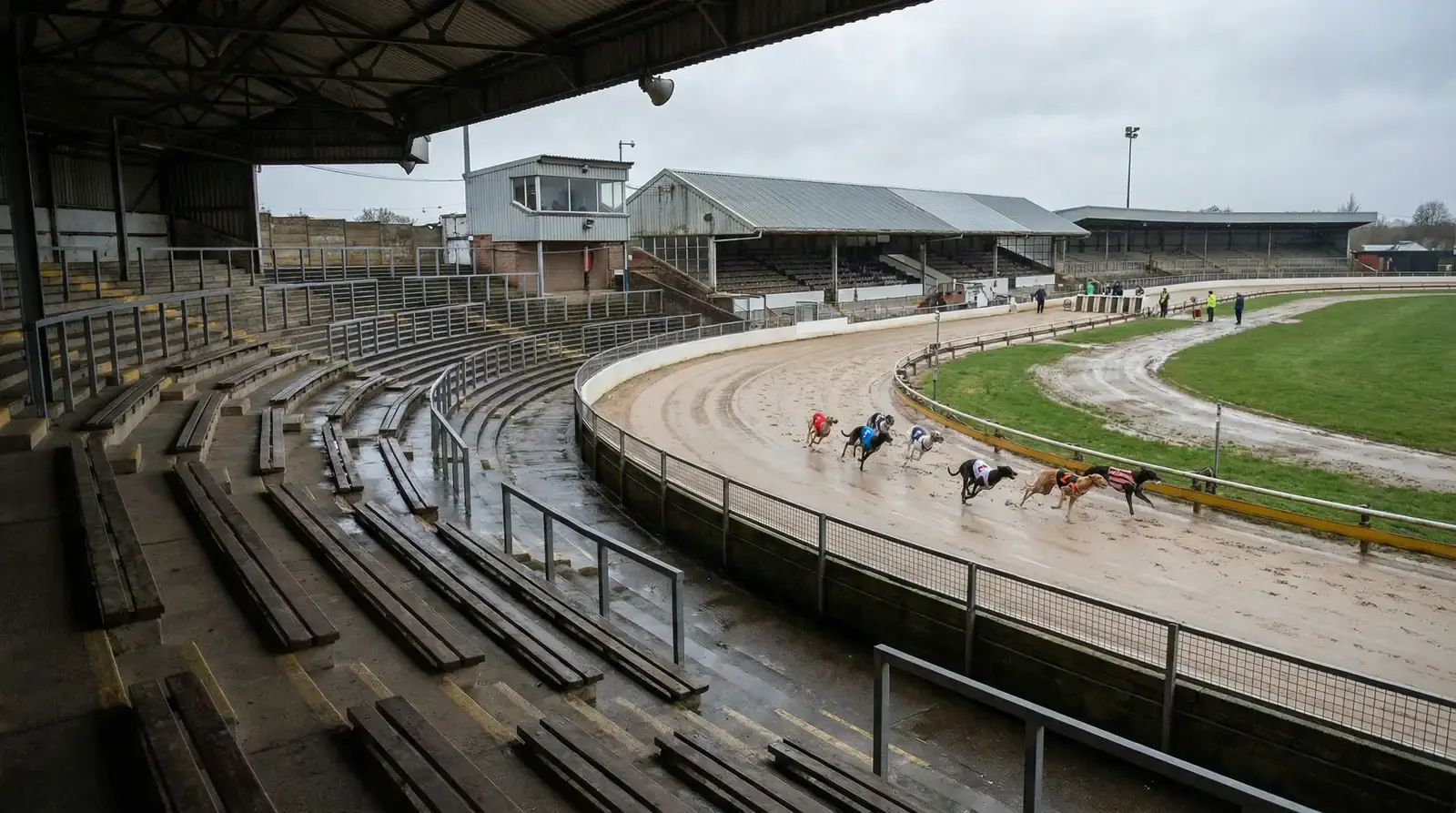
The Races Nobody Attends but Everybody Bets On
Walk past a UK greyhound track on a Tuesday afternoon and you will find the grandstand empty, the turnstiles closed, and the car park near-deserted. Yet inside the stadium, six dogs are loading into the traps every twelve minutes, a camera is broadcasting the action to every betting shop and bookmaker website in the country, and millions of pounds are being wagered on the outcomes. These are BAGS meetings — the daytime fixtures that keep UK greyhound racing alive between the evening cards that draw the crowds.
BAGS racing is the commercial engine of British dog racing. It generates the majority of the sport’s turnover, funds prize money at tracks that might otherwise struggle to survive, and provides a constant stream of betting content to an industry that needs product on its screens every hour of every day. Understanding what BAGS meetings are, how they differ from evening racing, and what they mean for bettors is fundamental to navigating the full greyhound schedule.
What BAGS Stands For and How It Works
BAGS stands for the Bookmakers’ Afternoon Greyhound Service. It is a funding mechanism through which licensed bookmakers collectively pay for daytime greyhound racing to be staged and broadcast. The bookmakers need betting content during the afternoon hours — between the morning horse racing and the evening dog cards — and BAGS provides it.
The funding flows from the bookmaking industry to the tracks. In return, the tracks stage meetings to a specified timetable, with races spaced at regular intervals to maintain a continuous betting product. SIS — Satellite Information Services — handles the broadcast, delivering live race feeds from the tracks to betting shops and online platforms. The entire operation is designed around the needs of the betting market rather than the spectating public.
BAGS meetings run at tracks across the UK on a rotating schedule. On a typical weekday, three to five BAGS meetings may run simultaneously between late morning and early evening. The specific tracks vary by day, but the result is a near-continuous flow of greyhound races from approximately 10:30am to 5:00pm, with a new race starting somewhere in the country every few minutes.
The commercial arrangement means BAGS meetings operate under slightly different conditions from evening cards. Prize money is typically lower, the on-course facilities are minimal (many BAGS meetings are closed to the public), and the competitive standard of the racing is generally below that of the featured evening fixtures. These are working meetings — functional, efficient, and built for wagering rather than entertainment.
How BAGS Meetings Differ From Evening Cards
The most significant difference is the quality of the fields. Evening cards at major tracks feature the top-graded dogs — the open class runners, the feature race entries, the dogs that trainers have specifically prepared for competitive racing under lights. BAGS meetings tend to draw from the middle and lower grades. The strongest dogs at each track are typically reserved for the higher-profile evening fixtures where the prize money is better and the competition is more visible.
This grading difference affects the betting in predictable ways. BAGS races with lower-grade fields often feature clearer form patterns — dominant dogs that have beaten similar opposition before, weaker runners whose limitations are well-documented, and form lines that translate more reliably from one race to the next. Evening cards, with their stronger and more competitive fields, produce tighter finishes, more upsets, and less predictable outcomes.
The market dynamics also differ. BAGS meetings attract less betting volume than evening cards, which means the odds are set by fewer participants and the prices are less responsive to form analysis. The bookmaker margins can be wider on BAGS races because the reduced competition among bettors allows operators to maintain a higher overround. Best Odds Guaranteed may not always be available on BAGS fixtures, depending on the operator.
The pace of BAGS racing is relentless. Races are scheduled every 12 to 15 minutes, across multiple tracks running simultaneously. This frequency creates a fast turnover environment that can encourage rapid, undisciplined betting. The gap between races is barely enough to study the next card in detail, let alone recover from a losing result. For bettors who thrive on volume, this is appealing. For those who value careful analysis, it requires deliberate self-restraint.
The atmosphere is another distinction, though it affects bettors less directly. Evening meetings carry a sense of occasion — crowds, commentary, pre-race build-up. BAGS meetings are silent affairs from the bettor’s perspective: a video feed, a result, and a racecard for the next contest. The stripped-down experience can actually be an advantage for analytical bettors, removing the emotional stimulation that evening meetings generate and allowing a more clinical approach to selection.
Betting on BAGS Meetings
BAGS racing suits a specific type of bettor: one who can analyse form efficiently, make quick decisions, and maintain discipline across a high volume of betting opportunities. The meetings are not inherently better or worse for betting than evening cards — they are different, and the approach needs to adjust accordingly.
The clearer form patterns in lower-grade BAGS races create opportunities for bettors who specialise in identifying strong favourites. When a dog has won three of its last four starts in the same grade at the same track and is drawn in a favourable trap, the form case is straightforward. These situations arise more frequently in BAGS racing than in evening cards, where the competitive balance is tighter and clear-cut favourites are rarer.
Forecast and tricast betting can be productive on BAGS meetings where the form strongly indicates a first and second but the market has not fully priced the combination. Lower-grade fields are more stratified — the best two or three dogs are often clearly superior to the rest — which makes the forecast permutations more predictable than in an open-class evening race where all six runners have realistic claims.
The risk of BAGS betting lies in the volume. With races every twelve minutes across multiple tracks, the temptation to bet on every race is powerful. Resisting that temptation is the single most important discipline for BAGS bettors. Select the meetings and races you have analysed, ignore the ones you have not, and accept that most of the afternoon’s racing should pass without your money being involved.
Tracking your BAGS results separately from your evening card results is useful for identifying whether the meetings suit your analytical style. Some bettors find that their edge is stronger on BAGS — the clearer form, the lower grades, the more predictable outcomes. Others find that the rapid pace and thinner markets erode their discipline. Knowing which camp you fall into shapes how much of your betting activity you allocate to daytime fixtures.
How Reliable Is BAGS Form?
BAGS form is generated under slightly different conditions from evening form, and those differences affect how much weight you give it when the same dog appears on an evening card.
A dog that has been winning BAGS races in D4 grade is proving its ability against a specific level of opposition on a specific type of meeting. When it steps up to an evening card in D3, the competition is stiffer, the race dynamics may differ, and the dog’s BAGS form may overstate its chances against stronger opposition. Conversely, a dog that has been struggling on evening cards and drops into a BAGS meeting may find the lower grade and weaker fields a comfortable fit.
Track-specific BAGS form is more reliable than cross-track BAGS form. A dog that wins at Crayford on a Tuesday BAGS meeting is proving its ability on that surface, at that distance, under those conditions. Transferring that form to a different track requires the same caution as any cross-track comparison — the distances, surfaces, and trap biases may differ.
Going conditions at BAGS meetings may vary from evening conditions at the same track. Daytime meetings run in different weather and light conditions, and the surface may behave differently at 2pm than at 8pm. A dog’s BAGS time on a warm, dry afternoon is produced under different conditions from an evening time on a cold, damp surface, even at the same venue.
The Engine Room of Greyhound Racing
BAGS meetings are the infrastructure that sustains UK greyhound racing. They generate the wagering revenue that funds the sport, they provide the race opportunities that keep dogs competing and trainers employed, and they supply the form data that feeds every racecard and results service. Without BAGS, the sport’s footprint would contract dramatically.
For bettors, BAGS meetings are neither the glamorous centrepiece nor an afterthought. They are a distinct segment of the market with their own dynamics, their own value patterns, and their own pitfalls. Approached with the right combination of selectivity, discipline, and adjusted expectations, they offer a productive and engaging extension to the evening cards that attract the wider audience.
