 Available in US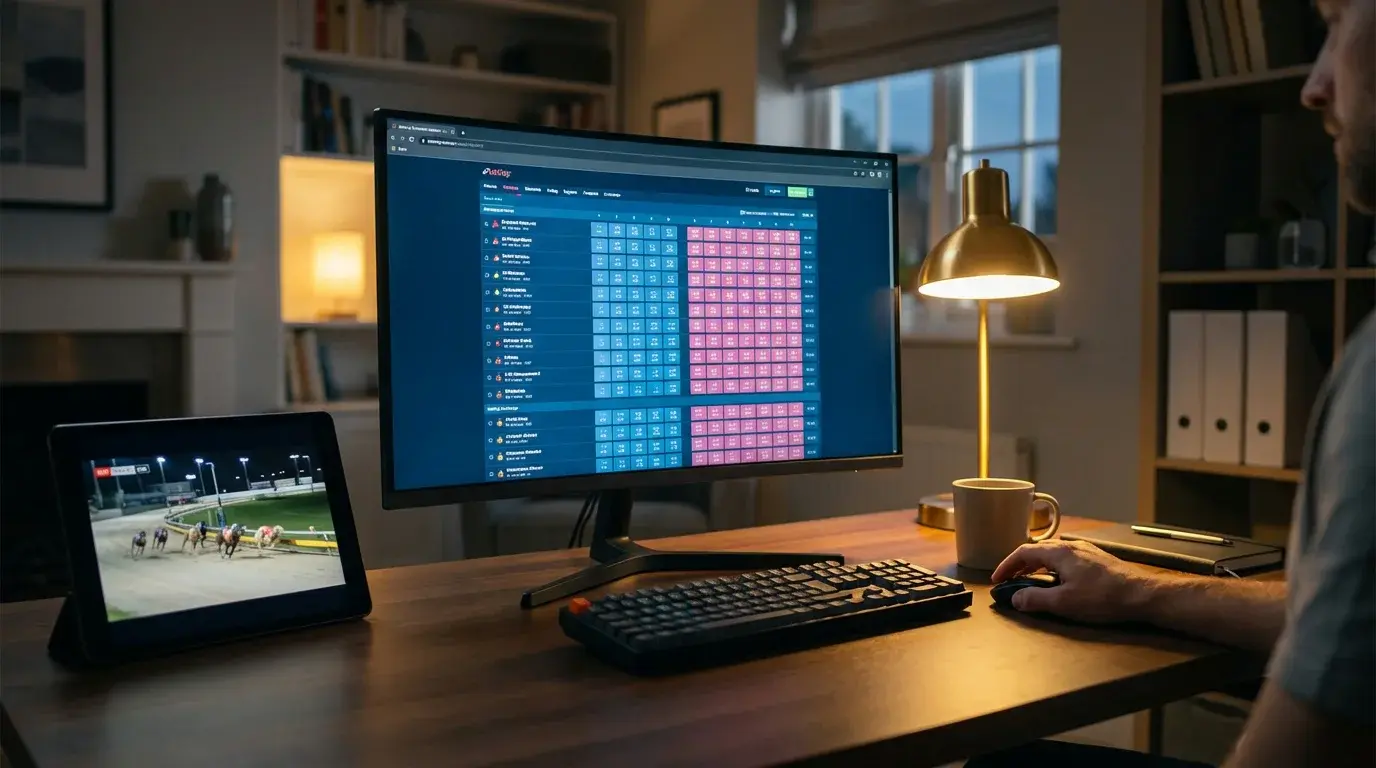
The Exchange Turns the Bookmaker Model Inside Out
With a traditional bookmaker, you bet against the house. The bookmaker sets the odds, decides the margin, and pays out from its own funds when you win. With Betfair Exchange, you bet against other punters. The odds are set by the market — by the collective supply and demand of bettors on both sides — and Betfair takes a commission on winning bets rather than building a margin into the price.
This peer-to-peer model changes the economics of greyhound betting in ways that matter. Exchange odds are often better than bookmaker odds because there is no built-in overround. The ability to lay — to bet against a dog winning — opens up strategies that are impossible with a traditional bookmaker. And in-play trading allows you to lock in profit or cut losses as a race unfolds, treating each event as a market to be managed rather than a simple win-or-lose proposition.
Betfair Exchange is not a replacement for bookmaker accounts — greyhound liquidity on the exchange is lower than in horse racing, and not every market suits the exchange model. But for bettors who want more control over their odds, more flexibility in their positions, and access to a fundamentally different type of market, the exchange is a powerful addition to the toolkit.
How Betfair Exchange Works for Greyhound Racing
Betfair Exchange operates as a marketplace where bettors offer and accept bets with each other. For every greyhound race, the exchange displays two columns of odds: the back price (the best odds available if you want to bet on a dog winning) and the lay price (the best odds available if you want to bet against a dog winning). The gap between the two is the spread, and it represents the market’s transaction cost — the equivalent of the bookmaker’s margin, but typically much narrower.
When you place a back bet on the exchange, you are not betting against Betfair — you are betting against another punter who has offered to lay that dog at the price you accept. When your back bet is matched, the exchange holds the stakes from both sides and distributes them to the winner after the race. Betfair’s revenue comes from commission, charged as a percentage of net winnings. The standard commission rate varies depending on the user’s chosen rewards package, typically ranging from 2 to 6 per cent, though it can be reduced for high-volume users.
Liquidity — the amount of money available to be matched — is the critical variable on the exchange. In horse racing, Betfair markets attract healthy liquidity, particularly for feature races and evening cards. But greyhound markets are significantly thinner than their horse racing equivalents. On a BAGS afternoon meeting, the available back and lay money might be modest, making it difficult to get large stakes matched at the displayed price. On a televised evening card, liquidity improves, but it still falls short of a competitive horse racing handicap.
The practical implication is that Betfair Exchange works best for greyhound bettors placing moderate stakes — typically in the range of five to fifty pounds per bet. At that level, you can usually get matched at or near the displayed price. Above that level, particularly on less popular meetings, you may need to accept worse odds or wait for your offer to be matched, which is not guaranteed.
Exchange odds are displayed in decimal format. A back price of 4.0 on the exchange is the equivalent of 3/1 in fractional odds — your return is four times your stake (three pounds profit plus one pound stake for every pound wagered). Lay odds work differently, and understanding the lay liability is essential before placing your first lay bet.
Backing vs Laying: Two Sides of Every Market
Backing on the exchange is functionally identical to placing a bet with a bookmaker — you stake money on a dog to win, and if it wins, you collect your profit minus commission. The difference is that exchange back prices are often better than bookmaker prices because there is no overround. Where a bookmaker might offer 3/1 on a dog (implying a 25 per cent chance), the exchange might show 3.5 (decimal) — the equivalent of 5/2 — because the market is set by supply and demand rather than by a margin-building algorithm.
Laying is the distinctive feature of the exchange. When you lay a dog, you are betting against it winning. You are, in effect, acting as the bookmaker for that selection. If the dog loses, you keep the backer’s stake. If the dog wins, you pay out at the agreed odds. Your liability — the maximum you can lose — is calculated as (lay odds minus 1) multiplied by the backer’s stake. If you lay a dog at 4.0 (3/1) for a ten-pound stake, your liability is thirty pounds: you will pay thirty pounds profit to the backer if the dog wins, on top of returning their ten-pound stake.
Laying is powerful because it allows you to express a negative opinion on a dog — something impossible with a traditional bookmaker. If you believe the 2/1 favourite is overbet and unlikely to win, you can lay it on the exchange. If any of the other five dogs wins, your lay bet succeeds. In a six-runner field, laying the favourite is effectively backing the other five runners simultaneously, weighted by the lay odds.
The risk of laying is that your liability can be substantial relative to your potential profit. Laying a short-priced favourite at 2.0 (evens) for twenty pounds means your liability is twenty pounds — you risk twenty to win twenty. Laying a longer-priced dog at 8.0 for ten pounds means your liability is seventy pounds — you risk seventy to win ten. The potential profit is smaller because the probability of the dog losing is higher, but the downside if it wins is severe. Managing lay liability is the single most important discipline for exchange bettors.
A common strategy combines backing and laying. You back a dog at a price you consider value, then lay it later at shorter odds to lock in a profit regardless of the result. This is trading — using price movements to guarantee a return — and it requires the price to move in your favour between the two transactions. If you back at 5.0 and the price shortens to 3.5 before the race, you can lay at 3.5 and distribute the profit across all outcomes. The mechanics are straightforward; the challenge is identifying the price movements correctly.
In-Play Trading on Greyhound Races
Betfair offers in-play markets on most UK greyhound races, meaning you can back and lay dogs while the race is running. In-play greyhound trading is fast, volatile, and not for the faint-hearted — a race that lasts thirty seconds compresses all market movement into half a minute, and prices swing dramatically with every stride.
The in-play market reacts to what is happening on the track in real time. A dog that breaks fast from the traps and leads into the first bend sees its price shorten rapidly — from 4.0 to 2.0 or lower within seconds. A dog that misses the break and is caught in traffic drifts from 3.0 to 10.0 or beyond. These price movements create opportunities for bettors who can watch the race live and react faster than the market.
The most common in-play strategy is to back a dog before the race and lay it in-play after it takes the lead, locking in a profit. If you backed at 5.0 pre-race and the dog leads at the first bend with its in-play price at 1.8, laying at 1.8 guarantees a profit however the race finishes. The challenge is the speed required — greyhound in-play markets move in fractions of a second, and a delay of even two or three seconds can mean the price has moved past your target.
In-play trading on greyhounds demands live video with minimal delay, a fast internet connection, and a pre-planned strategy for what price movements you will act on. It is not suited to bettors watching a delayed stream on a bookmaker’s website — the few seconds of lag between the live action and the stream mean the market has already moved by the time you see the event. Dedicated exchange bettors use the lowest-latency video feeds available and pre-load their bet slips before the race to minimise execution time.
The rewards can be significant for skilled in-play traders, but the risks are equally sharp. A dog that leads at the first bend and then falls at the second can swing from 1.5 to 50.0 in an instant. If you have not exited your position, the loss is sudden and total. In-play greyhound trading is a specialism within a specialism, and most bettors are better served by the pre-race exchange market where time pressure is lower and analysis can be more deliberate.
Exchange vs Bookmaker: When to Use Which
The exchange and the bookmaker each have advantages for greyhound betting, and the smart approach is to use both rather than committing exclusively to either.
Use the exchange when the back price is better than the best bookmaker price and sufficient liquidity is available to get your stake matched. Use it when you want to lay a dog — an option bookmakers simply do not provide. Use it when you want to trade a position in-play or close a bet before the race for a guaranteed outcome.
Use the bookmaker when BOG is available and you want early-price protection. Use it when the exchange liquidity is thin and you cannot get matched at a reasonable price. Use it for forecast and tricast bets, which the exchange does not support. Use it when you want the simplicity of placing a bet and walking away without managing a position.
Many experienced greyhound bettors maintain both a Betfair Exchange account and two or three bookmaker accounts. They compare the exchange back price (minus commission) against the best bookmaker price for each selection and place the bet where the effective return is highest. This comparison takes seconds and, across hundreds of bets, produces a meaningful improvement in overall returns.
A Market of Your Own
The exchange gives you something no bookmaker can: the ability to set your own terms. You choose the price, you decide whether to back or lay, and you manage your position as the market evolves. That control comes with responsibility — understanding liability, managing liquidity constraints, and maintaining discipline in fast-moving in-play markets — but for bettors willing to learn the mechanics, it opens a dimension of greyhound betting that the traditional model cannot match.
Betfair Exchange is not the whole answer for greyhound bettors. It is one tool among several, best deployed alongside bookmaker accounts in a strategy that uses each platform for what it does best. The bettors who extract the most value are the ones who know which tool to reach for in each situation — and who understand that having the choice is, in itself, an advantage.
