 Available in US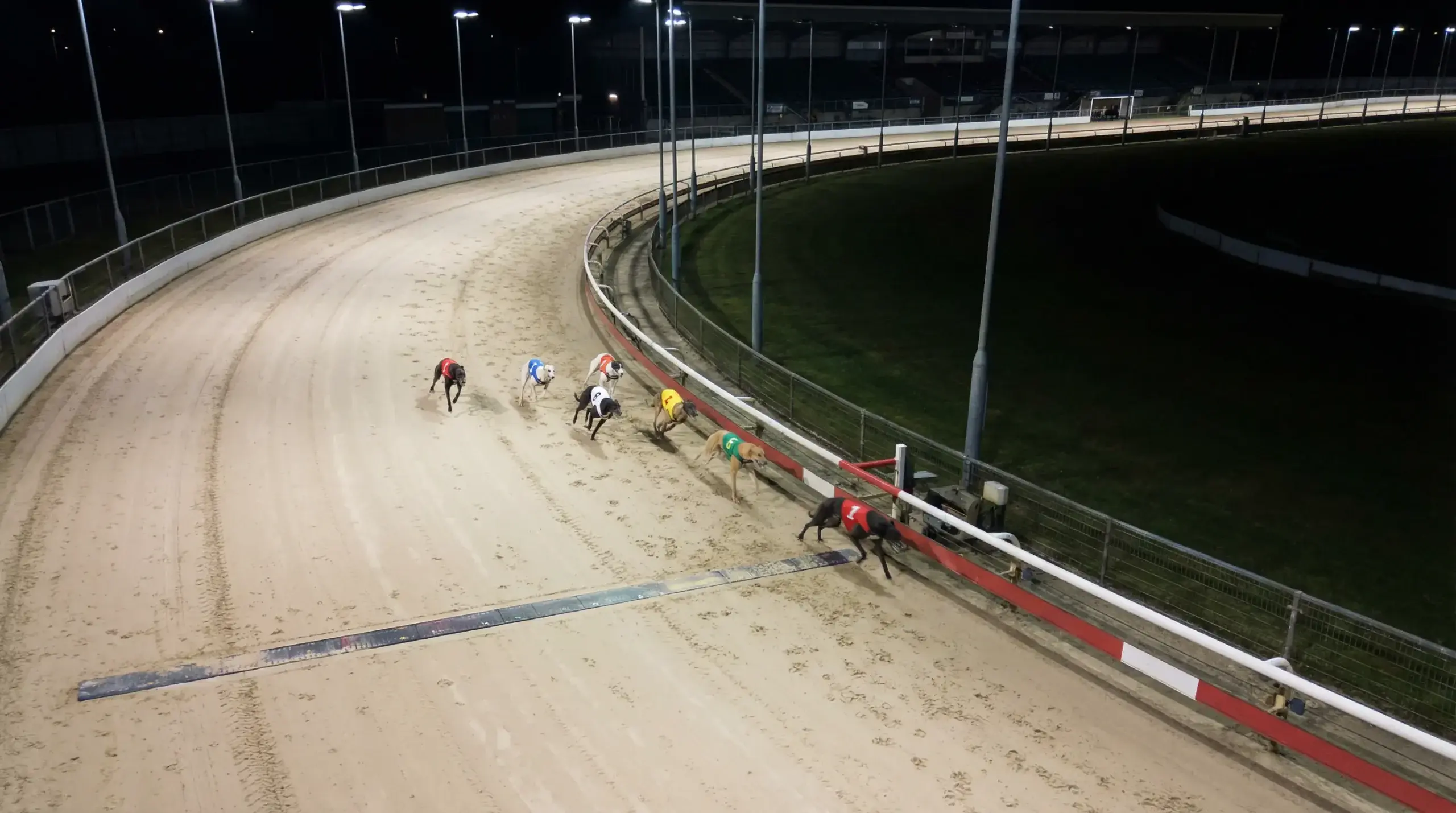
The Finish Time Is a Summary — the Splits Are the Story
A greyhound’s overall race time tells you how fast it covered the total distance. What it does not tell you is how that speed was distributed across the race. Did the dog blaze out of the traps and fade in the closing stages? Did it start slowly and power home? Was its pace even throughout, or did it lose time on one particular bend?
Sectional times — split times recorded at intermediate points around the track — answer these questions. They break the race into segments and reveal the pattern of pace beneath the headline number. Two dogs can post the same overall time yet run fundamentally different races, and sectionals are what make that difference visible.
For bettors, sectional data is one of the sharper analytical tools available. It exposes dogs with hidden ability — those that finish mid-pack but show sectionals suggesting they were unlucky or poorly positioned — and it identifies dogs whose impressive results were achieved from advantageous circumstances that may not recur. This guide explains what sectionals measure, how to read first-bend splits, how to compare times across different tracks, and how to apply the information to your selections.
What Sectional Times Measure
Sectional times record how long a dog takes to cover a specific portion of the track. The most commonly reported sectional in UK greyhound racing is the time from the traps to a point just past the first bend — typically measured at the first timing beam positioned after the opening turn. This first split captures the dog’s trap speed, its acceleration, and how efficiently it negotiated the initial crowding and bend.
Some tracks and data providers record additional sectionals — times at the second bend, the back straight, or other intermediate points — but the first-bend split is the most widely available and the most analytically useful. It is where the greatest variation between runners typically occurs and where the most consequential race events (interference, crowding, slow breaks) happen.
The overall race time, often referred to as the “run time,” is the time from trap rise to the finish line. The calculated time — published by some results services — adjusts the run time to account for going conditions and other factors, producing a standardised figure that can be compared across meetings. Sectionals, by contrast, are raw split times for specific segments. They are not adjusted for going, which means comparing sectionals between a meeting on fast going and one on slow going requires mental adjustment.
The value of sectionals lies in what they reveal about pace distribution. A dog with a fast first-bend split and a slower closing section is front-loading its effort — burning energy early to establish position. A dog with a moderate first-bend split and a strong closing section is conserving energy and finishing with pace in reserve. Neither pattern is inherently better than the other; what matters is whether the pattern suits the race conditions, the distance, and the dog’s running style.
Sectional data is available through specialist providers and some advanced racecard services. Timeform and Greyhound Stats both publish sectional information for UK meetings, though the depth and presentation vary. Standard bookmaker racecards rarely display sectionals — you need to use dedicated form resources to access this level of detail. The extra effort is worthwhile if you are betting regularly and want to move beyond surface-level form reading.
First-Bend Splits: Where Early Pace Shows Itself
The first-bend split is the most important single number in greyhound sectional analysis. It captures the opening phase of the race — the traps opening, the initial sprint, the approach to the first turn, and the negotiation of that turn — in a single time. Everything that happens in the first three to five seconds of a greyhound race is encoded in this split.
A fast first-bend split indicates a dog that traps well, accelerates quickly, and reaches the bend in a forward position. These dogs tend to lead into the first turn and often lead throughout the race, because early position in greyhound racing is difficult to surrender once established. Front-runners with consistently fast first-bend splits are the dogs that racecards describe as having “early pace” — the ability to reach the front before the crowding at the bend becomes a factor.
A slower first-bend split does not necessarily indicate a slow dog. It may indicate a dog that was hampered leaving the traps, one that was caught in traffic approaching the bend, or one that naturally takes a stride or two longer to reach full speed. The context of the split matters as much as the number. A dog that posts a moderate first-bend split but finishes with a fast overall time is demonstrating strong mid-race or closing pace — it lost time early and made it up later.
Comparing first-bend splits between dogs in the same race reveals the pace dynamic that is likely to unfold. If Trap 1 and Trap 2 both have dogs with fast first-bend splits, they are likely to contest the lead into the first turn, potentially causing crowding that benefits a dog in Trap 5 or 6 that can sit behind the scrap and pick up the pieces. If only one dog shows markedly faster sectionals than the rest, it is likely to lead unchallenged — and unchallenged leaders in greyhound racing convert at a high rate.
When examining first-bend splits over a dog’s last several runs, look for consistency rather than peak performance. A dog that posts a fast first-bend split in one run and a slow one in the next is unreliable out of the traps — its race pattern depends on which version of the dog shows up. A dog that posts similar first-bend splits across its last five or six runs, regardless of trap draw or going, is a dog whose early pace you can build a race picture around with confidence.
Comparing Sectional Times Across Different Tracks
Sectional times are not directly comparable between tracks. Each venue has a different track geometry — different distances from the traps to the first bend, different bend radii, different positions for the timing beams. A first-bend split of 4.50 seconds at one track might represent the same quality of early pace as a split of 4.80 at another, simply because the measurement points are in different places.
This means that the raw sectional number is meaningful only within its own track context. Comparing a dog’s first-bend split at Romford against its split at Monmore Green tells you very little unless you understand the baseline times at each venue. A split that is fast for Romford might be average for Monmore, or vice versa, because the physical distances involved are different.
The way to handle this is to compare each dog’s sectionals against the track average for that specific measurement point. If the average first-bend split at a given track is 4.60 seconds, a dog posting 4.45 is notably quicker than the norm, and one posting 4.75 is notably slower. The deviation from the track average — rather than the absolute time — is what tells you something about the dog’s relative early pace.
Some form services provide this contextualisation automatically, presenting sectionals as “above average” or “below average” for the track. Others present raw times and leave the interpretation to you. If you are working with raw numbers, build a simple reference by noting the average first-bend split across twenty or thirty races at the tracks you bet on regularly. That baseline gives you a yardstick against which individual performances can be measured.
Cross-track comparison becomes important when a dog transfers from one venue to another. Its sectionals at the old track are useful for understanding its running style — whether it is an early-pace or closing type — but the specific times should not be carried over as direct predictions for the new venue. The style translates; the numbers do not. A dog that consistently beats the first-bend average at Track A is likely to show similar tendencies at Track B, but its actual split times will reflect Track B’s geometry and measurement positions.
Using Split Times in Your Betting
Sectionals slot into your form analysis at the point where standard form reading runs out of detail. When two dogs have similar recent finishing positions and similar overall times, sectionals can be the tiebreaker. The dog with the faster closing sectionals might be improving and unlucky not to have won. The dog with the faster opening sectionals might have been flattered by unchallenged front-running in a weak field.
One specific application is identifying unlucky losers. A dog that posts the fastest closing sectional in a race but finishes third was likely caught behind traffic or hampered at the bends. If that same dog draws a better trap next time — one that gives it more room to run its race — the sectional evidence suggests it has the pace to improve its finishing position. The market may still price it as a recent loser; the sectionals tell a different story.
Sectionals also help with distance assessments. A dog with fast early sectionals but declining closing splits may be better suited to a shorter distance, where the race ends before its stamina runs out. A dog with moderate early splits but strong closing times might thrive over an extra fifty or a hundred metres, where its endurance becomes an advantage. When a dog is entered at a distance it has not tried before, its sectional profile gives you a basis for estimating whether the move will suit.
The investment in learning to read sectionals pays back through better race comprehension. You stop seeing a result as a simple finishing order and start seeing it as the outcome of pace dynamics that played out over thirty seconds. That depth of understanding makes your form reading more precise and your selections harder to replicate by anyone relying on headline figures alone.
Beyond the Clock
The finish line records one time. The sectionals record several. Each split time is a window into a different phase of the race, and together they reconstruct how the dog got from the traps to the line — not just how fast, but in what pattern. That pattern is the dog’s signature: the way it runs, the way it expends energy, the way it handles the demands of each section of the track.
Reading sectionals takes a little more effort than scanning finishing positions. It asks you to think about pace as a structure rather than a single number. The reward for that effort is a form picture with more dimensions than most of the market is working with — and in greyhound betting, extra dimensions translate into better decisions.
