 Available in US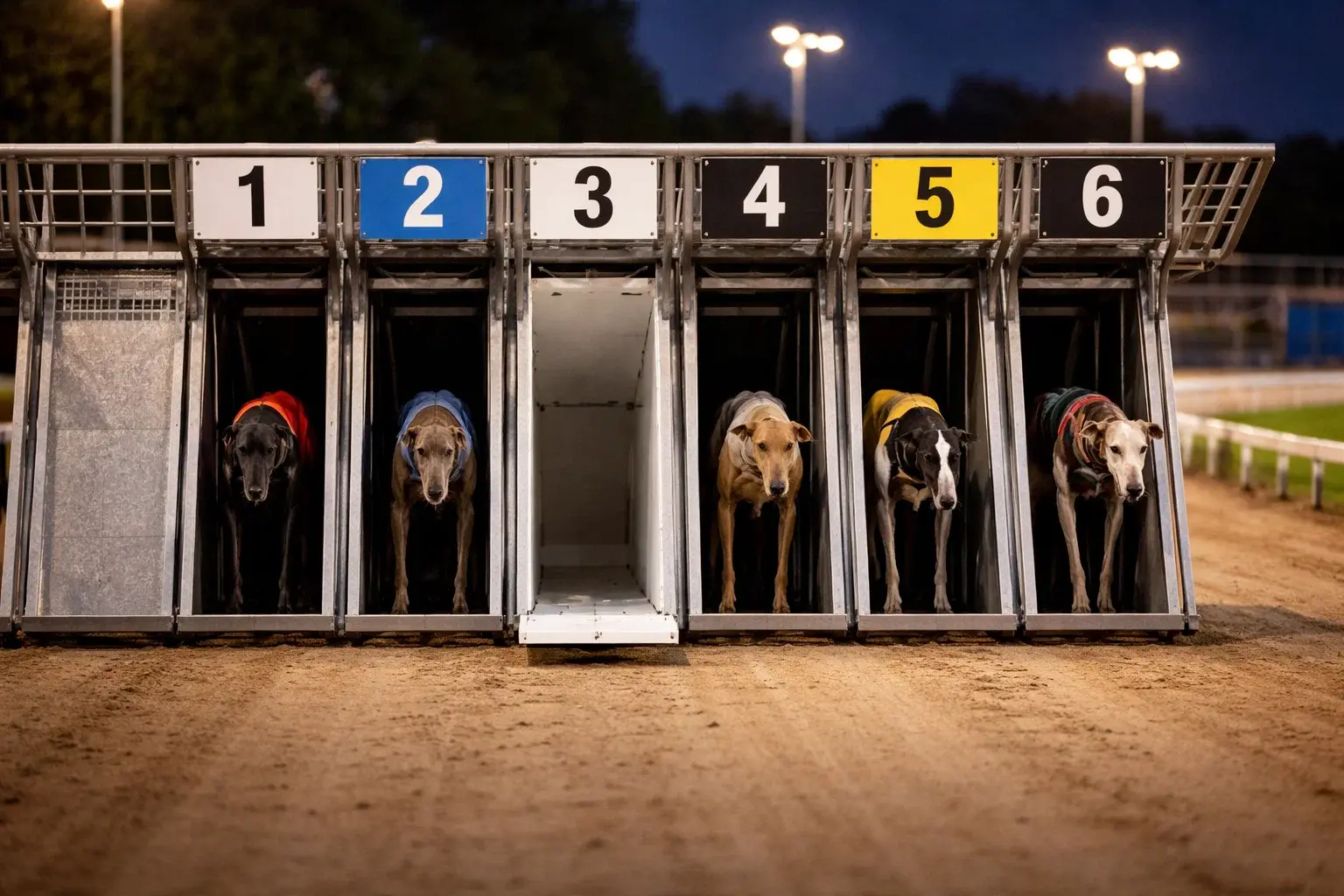
A Dog Scratched Means More Than an Empty Trap
You study the form, assess the traps, pick your dog, and place your bet. Then, an hour before the race, the dog is withdrawn. The trap is vacant. Your carefully selected runner is not running. Now what happens to your money?
Non-runners are a routine part of greyhound racing. Dogs get injured in warm-ups, fall ill in kennels, or are withdrawn by trainers who decide the conditions do not suit. The result is a race that runs with five dogs instead of six, an empty trap on the inside or outside, and a set of bookmaker rules that determine how every bet on the card is affected.
The settlement process involves voided bets, Rule 4 deductions, potential reserve runners, and knock-on effects for accumulators and other multi-leg bets. None of this is complicated, but the specifics matter — particularly the Rule 4 deduction scale, which can take a meaningful bite out of your winnings even when your selection was not the dog that was withdrawn.
What Happens When a Dog Is Withdrawn
When a greyhound is withdrawn from a race before the traps open, the immediate consequence is that the trap runs empty. UK greyhound races are designed for six runners, and a vacant trap is left in place — it simply opens with no dog inside. The race proceeds with five runners, or occasionally fewer if multiple withdrawals occur. The GBGB Rules of Racing govern the procedures around withdrawals and replacements at licensed tracks.
If you backed the withdrawn dog, your bet is voided and your stake is returned. This applies regardless of when you placed the bet — morning, afternoon, or minutes before the race. A void means the bet never happened: no profit, no loss, your money comes back. Most bookmakers process this automatically, crediting your account as soon as the non-runner is confirmed.
The timeline of the withdrawal matters for how other bets on the race are treated. If a dog is withdrawn before the bookmaker opens the market — typically before morning prices are published — the remaining runners are repriced to reflect the reduced field and no further adjustment is necessary. If the withdrawal happens after the market is already live and bets have been placed, Rule 4 deductions come into play.
Withdrawals can happen at various stages. Early withdrawals — announced the evening before or the morning of the meeting — give bookmakers time to adjust prices and may not trigger Rule 4 at all. Late withdrawals — at the track, during the kennel inspection, or during the warm-up — are the ones that activate the deduction rules, because bets have already been struck at prices that assumed a six-dog field.
The physical impact of the vacant trap on the race itself is also worth noting. An empty trap changes the dynamics at the first bend. If Trap 1 is vacant, the dogs in Traps 2 and 3 have more room on the inside. If Trap 6 is vacant, the wide runners have less traffic to contend with. These positional effects can favour or disadvantage the remaining dogs in ways that the original racecard assessment did not account for. A vacant trap is not just a betting event — it is a race event.
Rule 4 Deductions: The Price Adjustment You Cannot Avoid
Rule 4 is a deduction applied to winning bets when a runner is withdrawn from a race after the market has opened. It exists because the withdrawal of one dog changes the true probabilities of the remaining runners winning, but bets already placed were struck at prices calculated for the full field. Without Rule 4, bettors who backed the remaining runners would receive payouts based on odds that were too generous — the withdrawn dog’s probability has been redistributed among the survivors, making each of them more likely to win than the original odds implied.
The deduction is a percentage taken from your winnings, not from your stake. The percentage is determined by the starting price of the withdrawn dog at the time of withdrawal. The shorter the price of the non-runner, the larger the deduction — because the withdrawal of a strong favourite redistributes more probability to the remaining field than the withdrawal of a rank outsider.
The standard Rule 4 deduction scale used by UK bookmakers is published by the industry and follows a fixed table. At the extreme, if an odds-on favourite (priced at 1/3 or shorter) is withdrawn, the deduction can be as high as 75 pence in the pound — meaning 75 per cent of your winnings are removed. If a mid-priced dog at 3/1 is withdrawn, the deduction is typically around 20 pence in the pound. If a long-priced outsider at 10/1 or higher is withdrawn, the deduction may be as low as 5 pence in the pound or even zero.
To illustrate: you back a dog at 5/1 with a ten-pound stake. It wins. Your profit before deductions would be fifty pounds. The dog withdrawn from the race was priced at 2/1, which triggers a Rule 4 deduction of 30 pence in the pound. Thirty per cent of your fifty-pound profit is deducted — fifteen pounds — leaving you with thirty-five pounds profit plus your ten-pound stake returned, for a total payout of forty-five pounds instead of sixty.
Rule 4 deductions apply to all winning bets on the race, not just those placed after the withdrawal was announced. If you placed your bet that morning at 5/1 and the dog was withdrawn that evening, the deduction still applies to your payout. The timing of your bet is irrelevant; what matters is that the market conditions changed between the time the price was set and the time the race was run.
Some bookmakers offer “non-runner, no bet” (NRNB) promotions on selected greyhound races. Under NRNB terms, if there is a non-runner in the race, all bets are voided and stakes returned — not just bets on the withdrawn dog. This eliminates Rule 4 deductions entirely but also cancels your bet even if your dog would have won. NRNB is most commonly offered on feature races and major events rather than everyday cards.
Reserves and Late Replacements
Greyhound meetings typically have reserve dogs available to replace withdrawals. Reserves are standby runners — dogs that have been trialled, are fit to race, and can step into a vacant trap if needed. Whether a reserve is introduced depends on the timing of the withdrawal and the track’s operational protocols.
If a withdrawal is announced early enough — usually before a specified cut-off time set by the track’s racing manager — a reserve dog is inserted into the vacated trap. The race then runs with a full six-dog field. When a reserve replaces a withdrawn runner, the racecard is updated to reflect the new entrant, and bookmakers reprice the market to account for the substitute’s form and ability.
From a betting perspective, a reserve replacement resets the market. If you backed the original dog that was withdrawn, your bet is voided regardless of whether a reserve takes its place. If you had not bet on the withdrawn dog, the arrival of the reserve may change the complexion of the race — a strong reserve could shorten the prices of the other runners if it is competitive, or lengthen them if it is clearly weaker than the dog it replaced.
Late withdrawals — those that happen after the reserve cut-off — mean no replacement is possible. The trap runs empty and the race proceeds with five dogs. This is the scenario that triggers Rule 4 deductions on a live market.
It is worth noting that reserves are not always available. At some meetings, particularly smaller BAGS cards with fewer dogs in the kennels, there may be no suitable reserve for a specific race. The availability of reserves depends on the track’s pool of dogs, the grade of the race, and whether any standby runners are compatible with the distance and trap position. A vacant trap with no reserve is simply accepted and the meeting continues.
How Non-Runners Affect Multi-Bets
Non-runners in accumulator and other multi-leg bets have a cascading effect. If one leg of your acca involves a dog that is withdrawn, that leg is treated as a non-runner and removed from the accumulator. The remaining legs continue, but the acca is restructured: a four-fold becomes a treble, a treble becomes a double, and so on.
This restructuring reduces the potential payout because one multiplying factor has been removed from the chain. A four-fold at combined odds of 40/1 might become a treble at 10/1 after the non-runner leg is removed. The remaining legs still need to win, but the total return is materially smaller.
Rule 4 deductions, if applicable, are applied to the remaining legs within the acca. If a non-runner in a different race triggers Rule 4 on one of your surviving legs, the deduction reduces the return on that leg and the reduced amount rolls forward through the accumulator. Multiple non-runners across different legs can compound the effect, leaving a winning acca with a significantly lower payout than originally anticipated.
For forecast and tricast bets, a non-runner voids the bet entirely if the withdrawn dog was one of your selections. If the withdrawn dog was not one of your selections, the bet stands but the forecast or tricast dividend is recalculated based on the reduced field. A five-runner forecast dividend is typically smaller than a six-runner one because the probability of any given combination has increased with fewer dogs in the field.
The Absent Runner Still Shapes the Race
A withdrawn dog does not just leave an empty trap. It reshapes the field, triggers a chain of bookmaker rules, and alters the dynamics of a race that was built around six runners. The dogs that remain face different traffic at the first bend, different pace dynamics through the middle of the race, and an adjusted market that may or may not reflect their true chances accurately.
You cannot prevent non-runners, and you cannot always predict them. What you can do is understand the settlement rules that apply, account for the possibility when assessing your staking, and recognise that a race with a vacant trap is a different proposition from the one you studied on the card that morning.
